
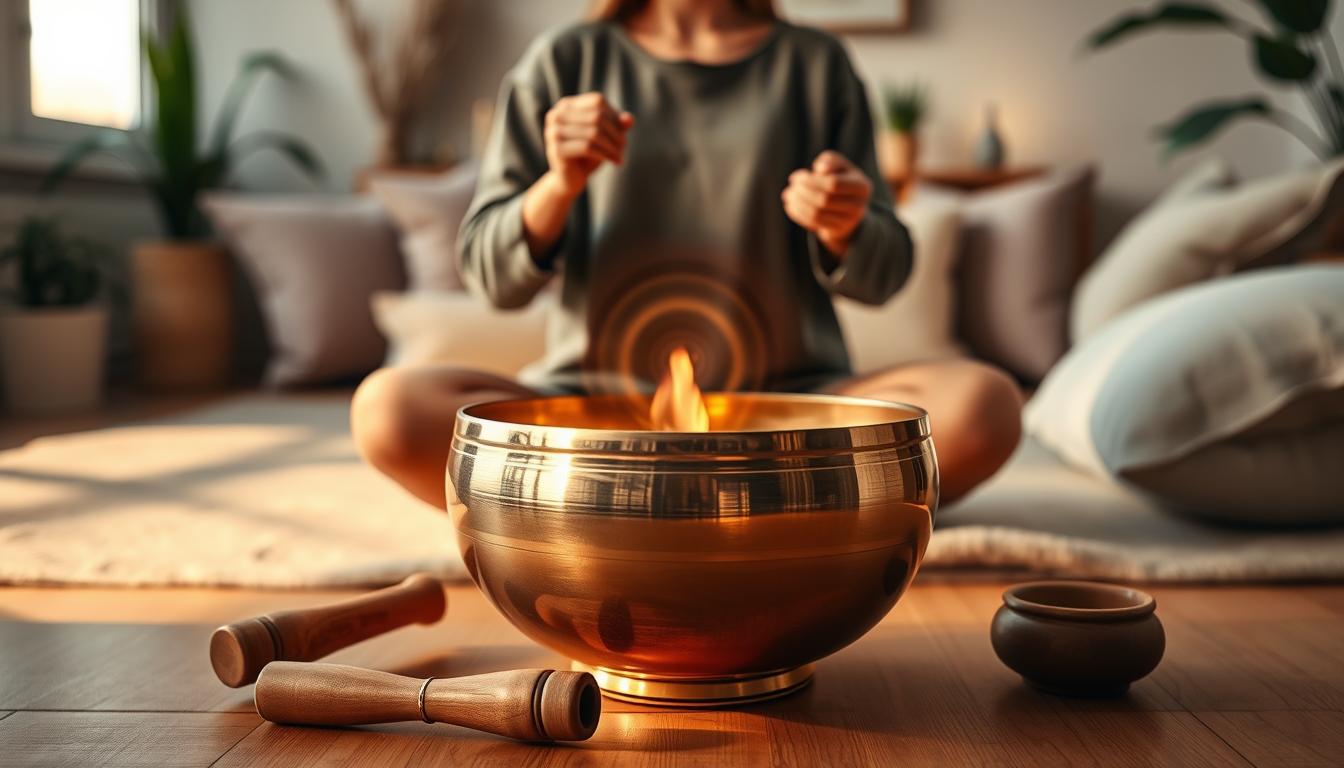
Practical and simple guide for beginners: here is a step-by-step approach designed to create a quick, accessible relaxation break. This text sets the scene, without jargon, for anyone looking for a concrete relaxation tool.
Goal: to offer a moment of bodily grounding through vibrations, while avoiding excessive promises. We will look at how to choose an instrument, prepare the space, and strike or rub the bowl safely.
The recommended session lasts 10 to 15 minutes. In today’s pace of life, often shaped by screens and stress, a short practice may be enough to bring immediate calm for some people.
“Simplicity first” approach: start with one bowl and a moderate volume. Important reminder: this is a complementary wellness practice, not a substitute for medical care.
Editorial promise: by the end of this guide, you will know how to structure a short routine, avoid common mistakes (overload, excessive volume, strikes too close together), and build a beneficial experience for your well-being.
Understanding the Tibetan singing bowl sound bath and its goals
It is a listening experience in which resonance guides attention toward a more peaceful state. The definition is simple: an immersion in sounds and vibrations that support relaxation of the body and calm the mind.
The vibrational logic is straightforward. An instrument emits waves through the air and vibrations that can sometimes be felt in the palm. The sensation is similar to a contactless massage.
- Main goal: slow the nervous system and create a mental pause.
- What makes it appealing: accessibility, short sessions, usefulness for reducing stress and supporting bodily grounding.
- Common sensations: a surrounding field of sound, steadier listening, release in the jaw and shoulders, and fuller breathing close to meditation.
“The pauses between sounds are just as important as the resonance: silence helps the experience settle in.”
To remain beneficial, the intensity should stay moderate. The goal is not sonic performance, but relaxation.
| Aspect | Expected effect | Practical advice | Recommended duration |
|---|---|---|---|
| Resonance | Auditory immersion | listen without judging | 5 to 10 min |
| Vibrations | Tactile sensation | place your hand on it if desired | short exposure |
| Silence | Integration | let the sound fade away | regular pauses |
To explore the vibrational logic and its applications in more depth, see a detailed presentation.
Possible benefits for stress, anxiety, and sleep quality
For some people, a few minutes are enough to slow mental pace and soothe anxiety.
Stress reduction
Many people describe quick calm and fuller breathing after a session. Common effects: reduced nervousness and a feeling of disconnecting from rumination.
Impact on sleep
Some people report falling asleep more easily and experiencing better sleep quality the following night. The improvement seems clearer when the session takes place at the end of the day.
Pain and tension
Muscle release is often observed, especially in the neck and shoulders. Some personal accounts mention a reduction in certain headaches thanks to relaxation and refocused attention.
What research is still exploring
Studies are promising but limited: small samples and varied protocols. Possible mechanisms include rest for the autonomic nervous system and lower cortisol.
Complementary practice, not medical substitute: use it to support a healthy lifestyle.
Simple self-assessment marker: rate your tension level out of 10 before and after the session, then track its evolution over several sessions to assess the benefits.
Choosing a Tibetan singing bowl suited to home practice
The right bowl directly affects sound quality and listening comfort. Before buying, prioritize listening to the sound over marketing promises.
Metal vs crystal
Metal: warm, rich harmonics and an enveloping sensation.
Crystal: purer frequency and clear projection, useful as a complement.
Concrete selection criteria
- Fundamental: listen for a clear, stable base note.
- Harmonics: richness without dissonance.
- Sustain: long, clean resonance.
- No buzz: no unwanted humming.
Size and sensation
A larger model produces enveloping low tones, felt in the torso. A smaller model remains more direct and higher-pitched.
“Prioritize clarity of sound and build quality over alloy stories.”
Recommended minimal kit
To begin: a versatile singing bowl (about 20 to 24 cm), a felt mallet, a suede-covered striker, and a ring cushion.
Testing method: hold the bowl, strike it gently, then record 10 seconds to compare several options objectively.
Preparing the space and body for a comfortable, safe session
Preparation matters as much as the sound. A simple, stable setting helps the mind let go more quickly. Before starting, turn off notifications and check the room temperature.
Create a supportive setting
Choose a quiet room with dim lighting and closed doors. Clear the path, lay down a blanket, and adjust the temperature for optimal comfort.
Tip: airplane mode on your phone and drawn curtains help prevent interruptions.
Posture and supports
Two simple options: lying on your back with a cushion under your knees to release the body, or sitting on a zafu for more attentive listening.
Add a mat, cushion, and blanket as needed to maximize relaxation.
Sound hygiene and progression
Start at low intensity. Increase slowly if everything remains comfortable. Leave pauses of silence between sounds to avoid auditory saturation.
Entry micro-routine and intention
Take 1 to 2 minutes of slow nasal breathing, release the jaw and shoulders, then begin with the first very gentle sound.
Set a simple intention: relaxation, recentering, or calming before sleep. The goal is not performance.
10 to 15 minutes is enough for a regular, accessible practice.
For a guided session and concrete reference points, see a short guided session.
Tibetan Singing Bowl Sound Bath: How to Practice It at Home
Before you begin, check that the intensity remains moderate and place the bowl at a comfortable distance from the ears. Do 1 to 2 short tests to validate the listening level and adjust the volume.
Striking technique
Hold the mallet loosely. Aim at the bowl wall with a slight angle and strike with a moderate impulse.
Always let the resonance fade before striking again to avoid saturation.
Rubbing technique
Start with a gentle strike, then place the striker against the outer rim. Rotate slowly.
Prioritize pressure rather than speed to stabilize the sound and reduce squeaking.
Solo placement and simple sequence (about 12 minutes)
Start near the feet (grounding), then at the pelvis, then the solar plexus, then near the throat, at a distance. Adjust according to how the body feels.
Sequence: 2 minutes of breathing/grounding, 3 minutes pelvis-solar plexus, 3 minutes rib cage, 2 minutes on the sides of the head at a distance, 2 minutes of integration silence.
Reference points and common mistakes
Adopt a slow pace: pauses of 10 to 20 seconds between impulses. Record a few sessions to refine your ear.
Avoid strikes that are too close together, too many instruments, and excessive volume near the head.
Listen to yourself: if a sound feels aggressive, move the bowl away, reduce the intensity, and take a break. To go further, see a detailed guide.
Practice variations to enrich the experience without making it complicated
Here are easy options to vary the session and stay centered. Three simple formats let you explore listening without multiplying gestures.
Guided meditation and accessible formats
Focus meditation: follow one sound and return to it when the mind wanders.
Open awareness: welcome all sounds without trying to filter them.
Visualization: imagine vibrational waves passing through tense areas.
Two-person practice: light sound massage
As a pair, prioritize gentleness and consent. Place a small instrument near the body, or on a cushion.
Golden rule: if the person says “too loud” or “it vibrates too much,” immediately lower the intensity and move the instrument away.
Wellness integration and use of other instruments
Combine gentle yoga and guided breathing before the session to open the breath. Leave a few minutes of silence afterward.
Tuning forks and other instruments can be added in small touches. Keep one main bowl and add a second only if the listening remains clear.
| Format | Benefit | Practical advice |
|---|---|---|
| Focus | Stabilizes attention | 1 main sound, 5 to 10 min |
| Open awareness | Welcomes mental movement | Slow breathing, no goal |
| Visualization | Strengthens bodily sensation | Image of waves, integrate for 2 to 3 min |
To go further: train, observe guided sessions, and test gradually rather than multiplying tools in the first week.
Precautions, contraindications, and safety rules to know
Before any session, it is important to identify situations that call for caution or medical advice. This practice can be beneficial, but it is not neutral for everyone.
Cases requiring particular vigilance
Consult a professional if you have: epilepsy, neurological disorders, hearing implants or cochlear implants, or severe psychiatric disorders.
Pregnancy and sound sensitivity
During pregnancy, reduce the intensity and avoid loud volumes, especially near the head. Favor short sessions and seek medical advice if in doubt.
Practical and mechanical safety
Never place a heavy instrument directly on the abdomen or chest. Check that it is stable on its cushion and avoid slippery surfaces.
Signals to stop immediately
- dizziness or nausea
- unusual headaches
- agitation or a feeling of oppression
If any of these signs appear, return to silence, breathe slowly, and stop the session. Contact a professional if symptoms persist.
Use framework and recommendations
Possible perceived effects include: calm, stress reduction, and improved sleep for some people. These effects remain variable, and this practice does not replace medical care.
Progression rule: if a previous session left you tired, lower the volume and shorten the duration next time.
After the session: hydrate, do a gentle activity, and observe sleep quality and stress level over 24 hours to adjust the next experience. For detailed precautions, see a practical article on needs and limits.
Conclusion
In short, a short, regular routine supports calm and relaxation.
Choose a suitable Tibetan singing bowl, prepare a quiet space, start gently, then combine striking and rubbing. Finish with silence for integration.
Typical session: 10 to 15 minutes, simple intention, moderate volume, and slow progression. Less, but better: one well-mastered singing bowl is better than several singing bowls that saturate listening.
Possible benefits include calm, reduced stress, and sleep support, with individual variation. If discomfort occurs, stop and consult.
Next step: practice 2 to 3 times a week for two weeks, note tension and sleep, then adapt placement and pace. For a guided session, see the recommended resource.