

Promise: learn a simple, reassuring method for practicing a short or longer session, even if you are just starting out.
Goal: prepare the space, choose a suitable bowl, produce a clear sound, and maintain a continuous tone to stabilize attention.
The central principle is clear: vibrations and sustain create a stable sensory reference point. This sound-based focus helps the mind return to the present whenever it wanders.
The progression below covers understanding the instrument, choosing one in France, preparing the setting, moving through the practice, then techniques and safety.
Practical tip: start with a few minutes and favor regularity over an occasional long session.
This practice supports relaxation and presence. It complements a healthy lifestyle, without replacing medical advice. For a detailed guide and buying tips, see this practical guide.
Why meditate with a Tibetan bowl today: sounds, vibrations, and recentering
Sound can become an instant anchor for calming the mind and returning to slower breathing. In a context of screen overload and mental fatigue, this reference point helps you recenter quickly between two commitments.
The timbre acts as an anchor: you follow the rise, the decay, and then the silence. This cycle naturally structures attention and breathing. The steady timbre works like an external mantra, often easier for a beginner to follow than a purely mental object.
Studies show measurable effects. A 2016 study at the University of San Diego (62 participants) noted reductions in stress, pain, and depressive symptoms after sound practices. A publication in the Journal of Evidence-Based Integrative Medicine also reported reduced tension and anxiety.
In practice, a few minutes are enough to create a relaxing pause. Effects vary from person to person, and this is not a medical treatment. If you have a significant anxiety disorder, keep professional support in place.
Brief results and application
- Common use: a short pause between tasks to reduce stress.
- Cumulative effect: regular repetition amplifies relaxation.
- Limit: subjective effect; a useful complement to medical follow-up.
| Observed effect | Indicative duration | Level of evidence |
|---|---|---|
| Reduced stress | 5-15 minutes | Pilot studies, promising results |
| Improved relaxation | A few regular minutes | Clinical observations and surveys |
| Breathing stabilization | Short sound cycles | Reported physiological correlations |
Next: to truly benefit from these effects, you need to understand harmonics and sustain, and learn the right gestures.
Understanding Tibetan singing bowls and how they work
These instruments emit layers of sound that quickly capture attention.
Simple definition: a singing bowl is both a percussion and friction instrument. It produces a main note and harmonics. These layers make the sound rich and easy to follow.
Origin: these instruments come from the spiritual traditions of the Himalayas. They are often made from an alloy of several metals. Their historical use includes rituals and mindfulness practices. Today, they support practice in France and elsewhere.
Harmonics are secondary frequencies. They give the timbre warmth and complexity. Sustain – the length of resonance – prolongs listening. This vibration supports attention and makes it easier to return to the present.
“Following the birth of the sound and then its disappearance anchors the mind effortlessly.”
A good instrument offers long sustain and a regular timbre. Quality can be heard in how well the sound holds and in the absence of buzzing.
| Characteristic | What it is | Impact on attention | Quality marker |
|---|---|---|---|
| Fundamental note | The main frequency emitted | Provides a stable anchor point | Clear timbre, no distortion |
| Harmonics | Secondary frequencies | Hold interest without effort | Rich, warm sound layers |
| Sustain | Length of resonance | Lets you follow the sound for longer | Long, regular sustain |
To go further and choose a good singing bowl, see this practical guide.
Choosing the right Tibetan bowl for beginners in France
The right beginner instrument is first recognized by how easy it is to play.
Frame the purchase: the goal is not the perfect bowl, but a model that sounds easily, feels pleasant in daily use, and suits home practice in France.
Metal vs. crystal bowls: timbre and use
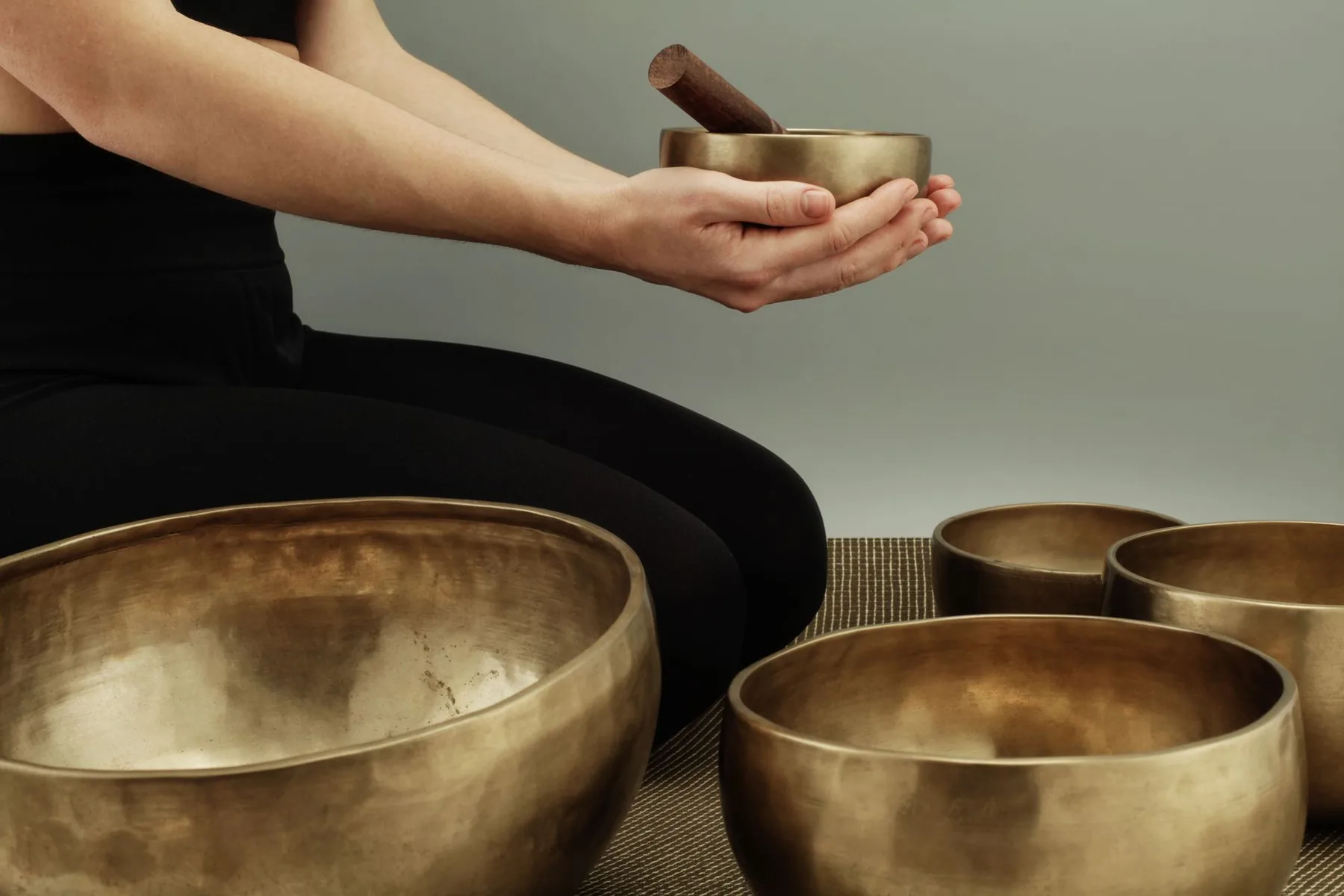
Metal offers a warm timbre and handles manipulation better. It suits beginners well.
Crystal (quartz) gives a sharper clarity, but it remains more fragile and requires caution.
Alloy, hammering, and quality markers
Favor a multi-metal alloy and visibly hammered craftsmanship. Look for an even rim, long sustain, and no buzzing when struck gently.
Size, low/high tones, and sensations
Large = enveloping low tones and more bodily vibrations. Small = more present high tones, a more mental sensation. A medium bowl remains versatile for beginners.
Dominant note and the chakra approach
You can use notes within a framework linked to the chakras, but prioritize the resonance felt in the palm and ease of play.
Simple test: strike gently, listen until silence, then rub slowly to check the stability of the singing tone. Ask for advice in a shop if you are unsure.
| Criterion | Indication | Impact |
|---|---|---|
| Alloy | Multi-metal, hammered | Sound quality |
| Size | Small/medium/large | High vs. low tones, vibrations |
| Sustain | Long and stable | Ease of listening |
Preparing the ideal setting before the session: space, posture, and holding the bowl
An orderly, quiet space makes listening easier and invites the body to relax.
Choose a corner of the living room or a bedroom, put your phone on airplane mode, close the door, and dim the light. These simple gestures create a regular setting and protect a few minutes for practice.
Create a calm, interruption-free atmosphere
Silence reduces breaks in attention and lets you perceive micro-variations in the sounds. Fewer interruptions = more stable attention and faster relaxation.
Accessible postures
Sit cross-legged or in half lotus if comfortable. Otherwise, choose a chair: back aligned, neck long. Support your forearm on your leg or a cushion to limit fatigue.
Place the bowl: palm or “donut” cushion
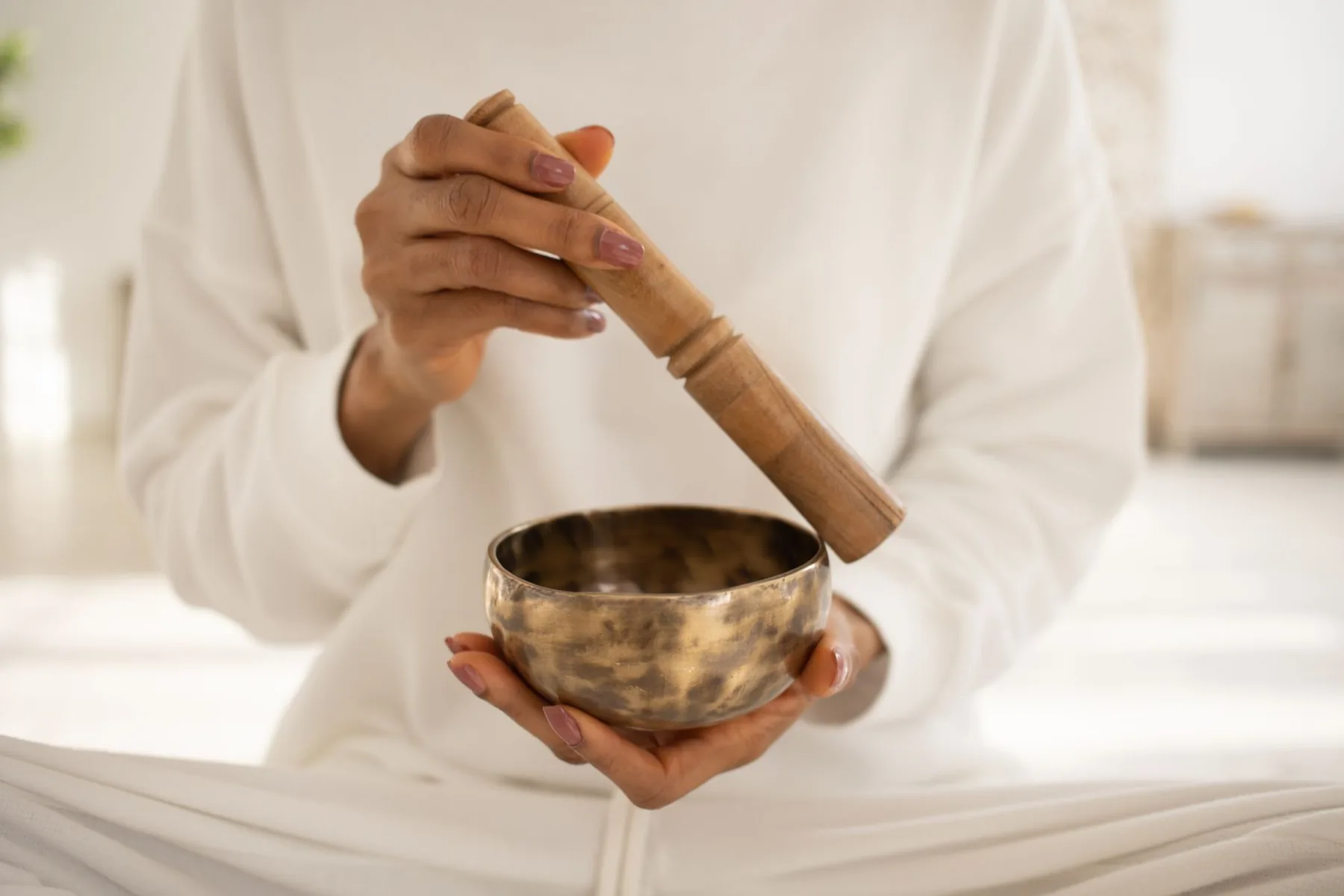
On the open palm, you feel the vibrations in the hand and body. On a donut cushion, sustain is often longer because the base breathes better.
Avoid interference
- Remove rings and bracelets that rattle.
- Do not place the bowl on a hard surface that muffles the sound.
- Avoid touching the wall with your fingers while it sings.
Tip: a few deep breaths are enough to shift into practice. For a buying and usage guide, see this practical guide.
Meditation with Tibetan Singing Bowls: A Step-by-Step Guided Session
A short ritual is enough: a clear intention, three deep belly breaths, then listening to the first sound.
Set a simple intention (calm the mind, feel the body, recenter myself). Seated, shoulders relaxed, inhale through the nose as the belly expands. Exhale slowly. Repeat three times to stabilize the practice.
Gently strike the bowl near the rim without forcing. Listen to the entire note until silence. Do not try to fill the mental space; remain an observer.
Settle attention by following the rise, decay, and micro-modulations. Notice the small vibrations and return to the sound whenever a thought appears.
Move into continuous singing if you wish: after an initial strike, rub the rim with a short, regular gesture for 1-2 minutes. Keep the movement stable and natural.
Recommended plan: 5-10 minutes for a first session, alternating a struck sound and 1-2 minutes of rubbing according to comfort.
To close, produce one final sound, keep a few breaths in silence, gently move your fingers and shoulders, then slowly open your eyes. Note in one sentence what changed in your state to anchor the experience.
| Step | Action | Indicative duration |
|---|---|---|
| Intention and breathing | Set an intention, 3 belly breaths | 1 minute |
| First sound | Strike gently and listen until silence | Repeat 2-3 times |
| Continuous singing | Rub the rim, short and stable gesture | 1-2 minutes |
| Closing | Final sound, integration silence, gradual return | 1-2 minutes |
To deepen use in a yoga context, here is a guide to using a bowl during yoga.
Essential techniques for sounding and singing the Tibetan bowl
The quality of the singing tone depends mainly on the angle, pressure, and rhythm of the gesture.
Striking technique
Hold the mallet like a pen and aim at the upper part, near the rim. Strike gently and let the mallet bounce to avoid a muffled sound.
Tip: several light strikes produce cleaner sustain than one strong hit. In an apartment, this technique remains more respectful of neighbors.
Rubbing technique
Place the tool on the outer rim at an angle of about 20-30 degrees. Maintain steady pressure and moderate speed.
When the gesture becomes constant, a continuous singing tone appears without buzzing. The harmonics rise gradually.
Head choice: wood vs. felt/suede
A wooden head offers a lively, clear attack, more “yang.”
A felt or suede head rounds out the timbre and produces a more enveloping sound.
- Favor the quality of the gesture over force.
- Adapt the size and firmness of the head to the bowl diameter to avoid saturation.
| Action | Adjustment | Expected result |
|---|---|---|
| Strike | Mallet held like a pen, bounce | Clean sustain, clear attack |
| Rub | 20-30 degree angle, steady pressure | Continuous singing tone, progressive harmonics |
| Head | Wood / felt-suede | Clarity (yang) / roundness (enveloping) |
Stable pressure and speed are the key to making the instrument sing without fatigue.
Duration and frequency: structuring a realistic practice in a few minutes
Structuring practice time helps turn a habit into an observable result.
Recommended durations according to your goal:
Concrete formats
Beginner: 5-10 minutes. This format builds the habit without demanding too much time.
Deep relaxation: 10-20 minutes for tangible relaxation and clearer effects on stress.
Long sessions: 20-60 minutes when your schedule and energy allow, for deeper inner work.
Regularity vs. intensity
Build a habit
Regularity wins: a short, frequent appointment trains the brain more effectively.
Choose simple time slots: morning to clear the mind, evening to decompress, or just before a demanding task to return to a stable state of attention.
- Progression: increase the duration in steps (e.g. +2 minutes per week) if it remains comfortable.
- Simple criterion: the practice must be doable without friction; 7 minutes daily is better than 45 minutes once a month.
Evaluation marker: observe sleep, tension, and concentration; adjust frequency according to the effects you feel.
| Goal | Duration | Recommended frequency |
|---|---|---|
| Start the habit | 5-10 minutes | Daily |
| Noticeable relaxation | 10-20 minutes | 3-5 times/week |
| Deepening | 20-60 minutes | 1-3 times/week |
Variations to enrich the experience without making it complicated
Modest adjustments offer new sound and sensory textures. They aim for better listening without multiplying accessories.
Meditating with water
Partially fill the bowl, rub gently, and observe the ripples. The water creates a subtle crackling that transforms the sound color.
Precaution: empty and immediately dry the inside and outside to avoid corrosion and stains. This step protects the instrument.
Alternating metal / crystal
Compare clarity and projection: metal provides grounding, while crystal raises the register.
| Material | Clarity | Felt sense in the body |
|---|---|---|
| Metal | Warm, rich | Deep grounding |
| Crystal | Pure, projected | Lightness, elevation |
Format with a practitioner
In France, a practitioner begins with a welcome and a discussion of your needs. Consent is requested for any contact.
You are settled fully clothed, then the sound work takes place around or sometimes on the body. Returning to calm includes hydration and integration time.
“People often feel relaxation, increased body awareness, and lengthened breathing.”
- Ask for advice in cases of sound hypersensitivity, frequent migraines, or specific medical conditions.
- Adjust volume and proximity to stay comfortable.
Common mistakes, safety, and important precautions
An unstable singing tone usually reveals a gesture or support that is poorly adjusted. Here is how to diagnose and correct quickly to preserve the quality and effects of your practice.
Typical mistakes: fingers touching the wall, bowl held too tightly in the palm, changing pressure, speed too fast and blocking the sound.
How to diagnose: if the sound buzzes from the start, check your hold and angle. If the singing tone starts and then stops, suspect irregular speed or wrist fatigue.
Immediate corrections: slow down, reduce force, stabilize pressure, and support the forearm. Change the tip (wood vs. suede) if needed. Try a donut cushion to improve acoustic support.
Precautions for certain people: seek medical advice in cases of pregnancy (first trimester), epilepsy, pacemaker/metal implants, or sound hypersensitivity. Volume should remain comfortable; stop if you feel unwell, develop a headache, or feel unusual agitation.
Care and respect for the instrument: wipe with a damp cloth, then dry. After using water, immediately dry the inside. Protect the Tibetan bowl from impacts to preserve its quality and its effect on the body.
| Problem | Likely cause | Solution |
|---|---|---|
| Buzzing | Fingers on the wall / incorrect angle | Relax the hand, adjust the angle |
| Singing tone stops | Irregular speed or pressure | Slow down, stabilize the gesture |
| Short sustain | Hard support or bowl held too tightly | Use a donut cushion, place it on the open palm |
Conclusion
In the end, regular use transforms a short sound pause into a concrete well-being tool. Remember the essentials, intention and breathing: set a clear intention, take three belly breaths, strike gently, and listen until silence.
Then introduce a short, stable rubbing gesture to prolong listening. Start with 5-10 minutes, 3-4 times a week, then adjust toward 10-20 minutes according to the benefits you are looking for.
The main lever remains the sound of the singing bowl as an attention anchor. Progress through stable gesture, not force. Respect precautions (sound hypersensitivity, pregnancy, epilepsy, implants) and ask for advice if necessary.
With a simple bowl, a suitable mallet, and a calm setting, sound meditation becomes an accessible and soothing routine.