
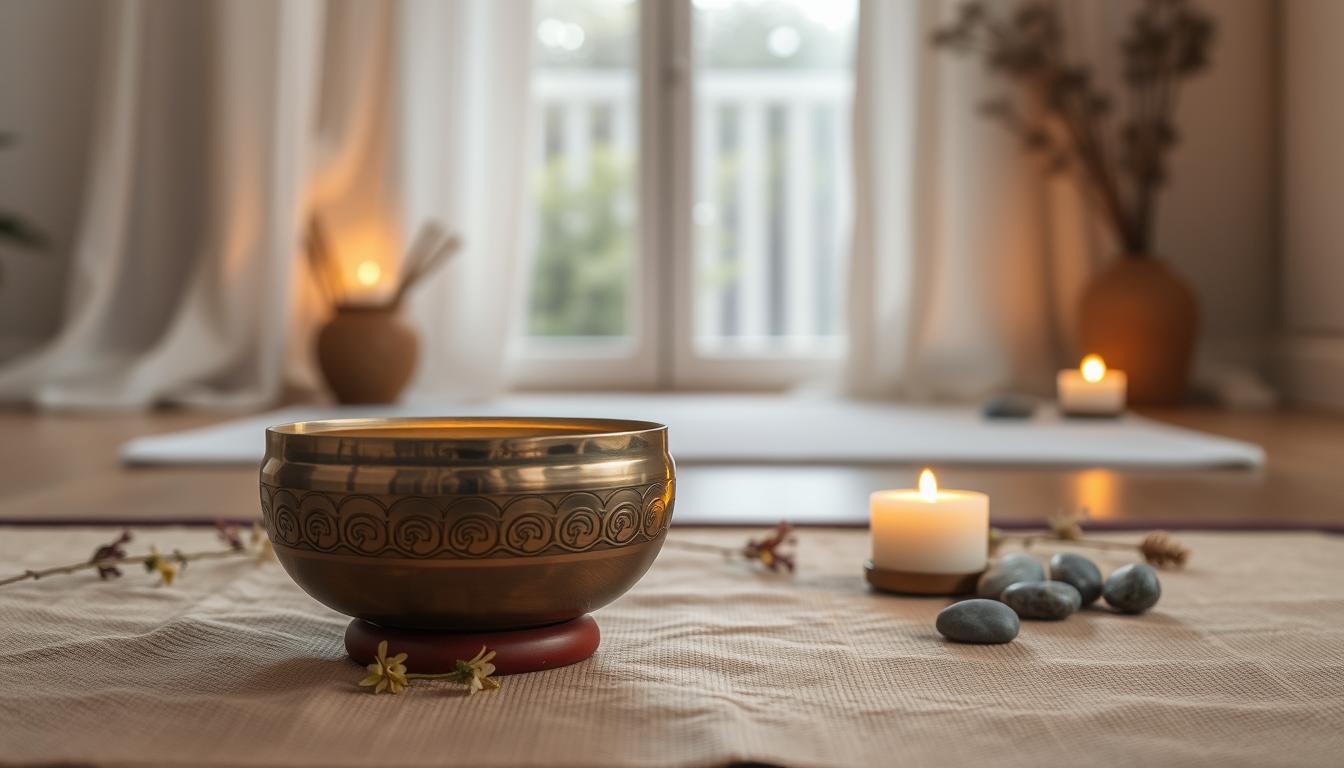
Goal: learn how to use a singing bowl to support a short or longer practice. This introduction explains why sound helps concentration and reduces stress.
Why sound works: a steady tone serves as a reference point when attention wanders. The timbre makes it easier to return to the present and creates an accessible focal point.
We offer a clear progression: understand the instrument, prepare the session, produce a clean sound, then follow targeted formats (stress management, concentration, body scan, evening session).
You will leave with practices that take only a few minutes for busy days, and deeper formats to extend the experience. The singing bowl can be played by yourself or by a guide, depending on your preference.
Safety basics: adopt a stable posture, choose a quiet environment, and listen to your body to avoid any tension during regular practice.
Why the Tibetan bowl helps you recenter during meditation
A steady sound can quickly refocus attention and calm an agitated mind. The principle is simple: the note acts as a focal point when thoughts drift away.
A sound anchor to calm the mind
The sustain of a tone or struck note offers a continuous reference. By listening to the attack, sustain, decay, and then the silence, you bring concentration back without judgment.
Vibrations, brain waves, and relaxation
The vibrations perceived in the air, and sometimes in the body, encourage relaxation in the nervous system. This phenomenon helps you enter a calmer state than practice alone.
What the research says (2016 study)
“Significant improvements were noted in mood, tension, anxiety, and pain after a session assisted by singing bowls.”
This University of San Diego study shows positive effects in many people. Science is still exploring the mechanisms, but the observed benefits are consistent with long-standing uses around the world.
- Useful practice: focus first on the attack, then on the sustain.
- Use the sound as a guide to return to the present moment whenever attention wavers.
Understanding the Tibetan singing bowl before you begin
Understanding the bowl’s history and physics helps you use it better in practice. This foundation limits buzzing and improves the effects felt during meditation.
Origins and traditional use in Asia
These instruments come from Himalayan regions: Tibet, Nepal, and India. They were used during rituals, offerings, and spiritual exercises.
Today, many people in the West use them for relaxation and meditation practice.
Alloy, resonance, and sensations
A singing bowl is a metal cup that vibrates when struck or rubbed. The wall produces a fundamental tone accompanied by harmonics, which gives the sound its richness.
People often refer to a “7-metal” composition: this multi-metal alloy encourages a distinctive sound signature and sustained vibrations.
- Size and thickness: influence the tone (low or high).
- Shape: changes the resonance duration and the sensation in the mind.
To go further, see everything you need to know about the singing bowl. A good understanding makes practice easier and optimizes the effects.
Preparing your Tibetan bowl meditation session
Set up a calm framework: choose a place without noise, turn off notifications, and close the door. Soft light and a stable support for placing the bowl help attention.
Choose the right place and limit distractions
Prefer a dedicated room or a quiet corner. Tidy the space in 1 to 3 minutes: adjust the light, remove unnecessary objects, and decide how long the session will last.
Set a simple intention for mind and body
Formulate a short sentence that guides the body-mind practice, for example “stabilize attention” or “release stress.” This intention guides the bowl meditation and structures the flow.
Posture, hand position, and comfort
- Straight back without stiffness, long neck, relaxed shoulders.
- Relaxed hands to hold the bowl or the mallet.
- Options: meditation cushion, chair, or yoga mat according to comfort.
| Element | Advice | Duration |
|---|---|---|
| Place | Quiet room, door closed, notifications turned off | 1-3 minutes |
| Intention | Short sentence (e.g. “recenter myself”) | Instant |
| Posture | Straight back, cushion or chair as needed | Throughout |
Holding and setting up your Tibetan bowl for a clean sound
Setting up the instrument correctly guarantees a pure timbre and lasting resonance.
Holding it in the palm
Hold the bowl flat in your palm, with your hand open. The grip should be gentle: do not enclose the cup. This lets the wall vibrate freely and produce clear sounds.
Remove rings and jewelry. Metal objects can create unwanted noise and alter the quality of the vibration.
Bowl placed on a cushion
If you set the instrument down, use a ring cushion. The support stabilizes the singing bowl and protects the resonance.
Avoid hard surfaces. Direct contact muffles the note and creates unpleasant vibrations.
Adapt according to weight and striker
A light bowl is comfortable in the hand for a short session. A heavy one should remain on a cushion for greater stability.
Adjust the position according to the mallet: a strong strike requires a secure base to prevent it from falling and to keep the gesture regular.
Producing the bowl’s sound: striking or making it sing
Producing a clear sound requires a precise gesture and attentive listening.
Striking and making it sing offer two uses: striking gives a single note that decays. Singing creates a continuous sound that sustains attention.
Mallet striking technique
Hold the mallet like a pendulum, without tension. Aim for the rim with a controlled gesture.
Choose moderate force: the note should be clear, not aggressive. Practice by making five identical strikes, then adjust the angle and intensity.
Technique for making the bowl sing
Start with a light strike, then rub near the outer rim in a regular circle.
The pressure should be gentle and constant. Keep the mallet in continuous contact to avoid buzzing.
Common mistakes and anti-buzzing tips
- Tilting the mallet or pressing too hard breaks the resonance.
- Skipping contact or gripping with the hand muffles the vibrations.
- A poorly positioned bowl produces a rough sound.
| Action | Advice | Effect |
|---|---|---|
| Strike | Hold the mallet loosely, aim for the rim | Clear and stable note |
| Make it sing | Constant pressure, regular speed | Continuous sound, sustained attention |
| Avoid | Excessive force, tilting, unstable contact | Buzzing, rough sound |
Tip: a steady sound becomes a direct support that helps calm the mind and prolongs the practice.
Tibetan Bowl and Meditation: Simple Routines to Recenter Yourself
Here are easy-to-apply formats suited to daily life. They adjust to the time available and use sound as a support for attention.
Express routine (3-5 minutes)
One clean strike, listening until it fades, then three slow breaths.
Repeat 2 to 3 times. This sequence quickly reduces stress and recenters the mind.
“Concentration” cycle
Make the bowl sing or strike it at regular intervals. Pair each sound phase with a breath.
For example: inhale during half a turn of the mallet, exhale during the other half. The rhythm stabilizes concentration.
Guided body scan
With each note, move your attention: head -> neck -> shoulders -> chest -> belly -> pelvis -> legs -> feet.
“Place” the vibrations in each area. This method helps relax the body and develop body awareness.
Evening routine (8-12 minutes)
Softer sound, slow gestures, longer silences. Focus on progressive relaxation of the body.
This prepares restorative sleep by reducing tension and slowing the mind.
Closing ritual and progression
Let the sound fade naturally. Then gently place your hand on the bowl to calm the vibration.
Adjust the number of cycles according to your time. Repeat these practices several times a week to notice the benefits.
For a step-by-step guide, see our dedicated article on how to use a bowl.
Synchronizing breath, sound, and gestures to enter meditation more deeply
Synchronizing breath, sound, and movement creates a simple framework that supports attention. This coordination reduces distraction and turns movement into a listening support.
Slow, deep breathing
Simple protocol: inhale during the first half of a circular turn of the mallet, then exhale during the second half. Do this without forcing the breath.
Stay in the experience
Focus on the tone: observe the attack, timbre, harmonics, and volume. When a thought arises, gently bring attention back to these sound elements.
- Regularity: a constant gesture stabilizes the mind and more quickly establishes a state of calm.
- Listening exercise: alternate 30 seconds of active listening (sound details) and 30 seconds of broad listening (including silence).
This way of practicing with a singing bowl helps deepen relaxation without multiplying mental instructions. To acquire a suitable instrument, discover our relaxation singing bowl offer.
Exploring variations: water, mantras, and guided meditation
Experimenting with sound variations enriches the practice and offers new sensations.
With water: fill the instrument halfway, then make it sing. The changed levels alter the frequency and sound texture. Sometimes droplets dance and create a rain-like effect that captures attention.
This method offers useful visual feedback. The ripples strengthen concentration and make the experience more immersive.
Simple precautions
- Hold the object steadily and work with a regular gesture.
- Do not fill it beyond halfway to avoid splashing.
- Important: do not drink water charged in a metal instrument.
Guided meditation and mantras
Letting someone else play allows some people to release the effort of the gesture. A guided session encourages surrender and relaxation.
Pair a simple syllable (e.g. Om or Om Mani Padme Hum) with the exhale. Add this process at the end of a yoga session to support body-mind balance.
“Water changes the sound palette and helps attention through visible movement.”
| Variation | Effect | Precaution |
|---|---|---|
| Without water | Pure resonance, long sustain | Stable bowl, regular gesture |
| With water (1/2) | Rain-like sounds, visual feedback | Do not drink the water, limit filling |
| Guided meditation | Release without gestural effort | Choose an experienced player |
For a complete guide and step-by-step instructions, see how to use a bowl.
Choosing the right Tibetan bowl and mallet for your practice
A good match between cup and striker makes it easier to enter deep relaxation.
Useful criteria
Size and tone: a small instrument gives a higher note, while a large one produces enveloping low tones.
Resonance duration: choose a long sustain if you want a lasting focal point.
Harmonic richness: listen to the harmonics: they nourish attention and improve the experience.
Overview of types
| Type | Characteristic | Recommended use |
|---|---|---|
| Natural | Authentic sound, organic textures | Personal use, long sessions |
| Engraved | Often richer in harmonics | Meditative and guided practice |
| Shiny | Specific alloy, clear timbre | Short sessions and clean strikes |
| PATAN / OM SAJAN | Versatile, tonal balance | Mixed use, good for beginners |
| Full Moon | High-end, long sustain | Deep practices and studio |
Strikers and sound impact
The choice of mallet changes the attack: wood produces a clean strike. Leather or suede offers a softer, grippier singing tone.
Felt gives a rounder, less bright strike. Test several combinations to limit buzzing.
Final advice: choose an instrument/striker duo that fits the way you play. Test it by striking once, listen to the stability and richness, then compare in a quiet space.
Conclusion
Letting the sound fade naturally better anchors the feeling of calm. End each session by letting the vibration decay or by calming the bowl with your palm. This helps body and mind remain soothed.
In summary: the instrument is a simple support for returning to the body, stabilizing the mind, and making meditation more accessible.
Before each practice, prepare a calm place, hold or place the bowl correctly, choose striking or singing, then apply a suitable routine. A few minutes, several times a week, are better than one long isolated session.
Increase the duration gradually and test different approaches. For advice on mindfulness meditation, see our guide.