
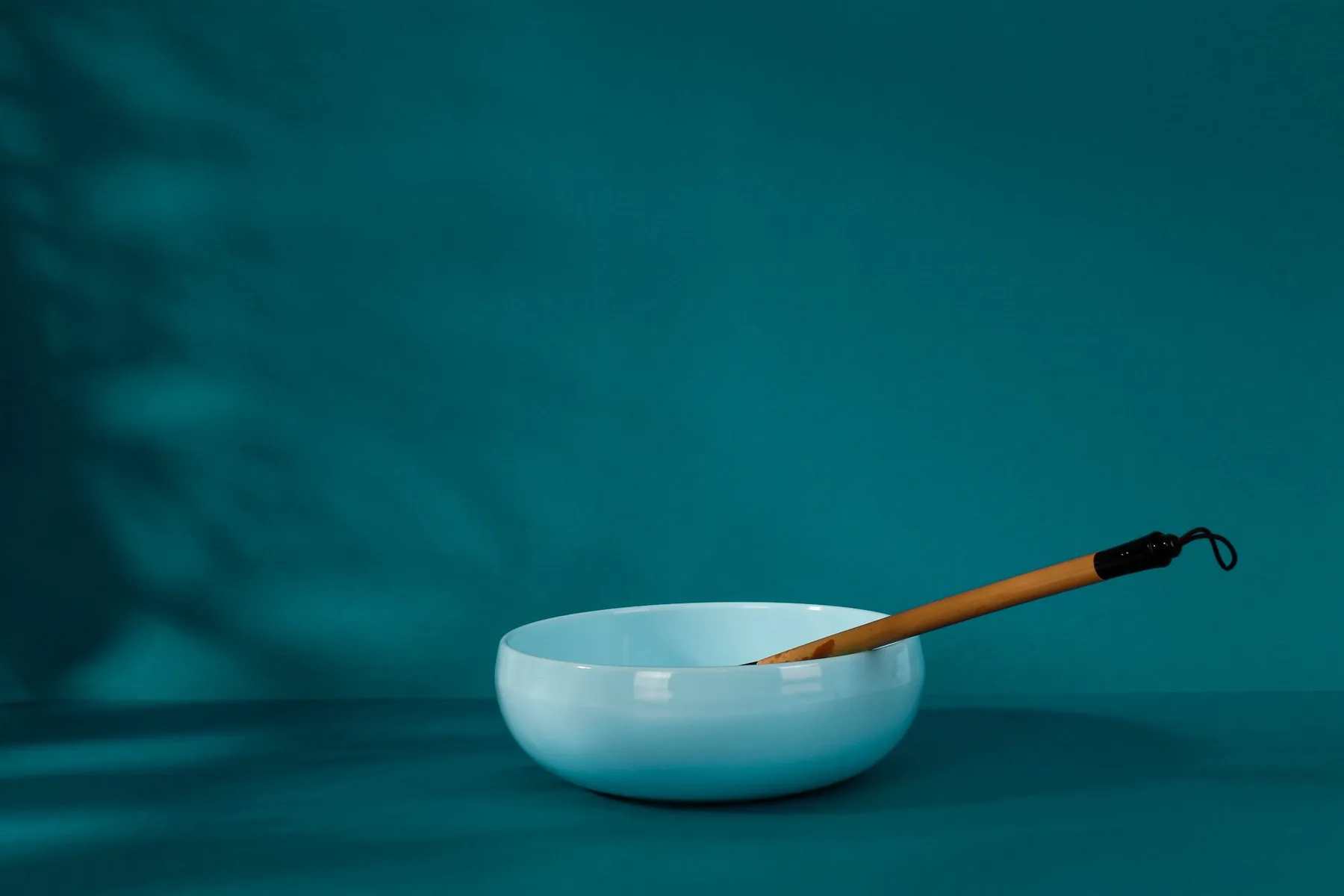
Goal: help a beginner understand this instrument, choose a suitable first bowl, and use it from the very first session.
This article offers a clear roadmap: understand the vibrations, choose the instrument, learn the posture, master the techniques, and build a routine.
Two playing methods will be explained throughout the text: striking and rubbing, with concrete pointers to avoid common mistakes.
Framework: relaxation, meditation, and wellness sound therapy. No medical promise is made; the effects remain subjective and reported by practitioners.
To establish credibility, we will give measurable criteria (resonance sustain, rubbing consistency) and a progression logic: one bowl, one tool, one routine.
Practical note: it is normal not to make the bowl sing perfectly in the first minute. Consistency matters more than performance.
For concrete techniques and pointers, see this practical guide: techniques and instructions.
Understanding the Tibetan singing bowl and singing bowls today
Between striking and rubbing, a singing bowl is a percussion instrument that produces sounds and vibrations. It is activated either with a brief strike or with regular rubbing that sustains the resonance.
Definition
The term refers to a family of metal objects. These instruments generate a fundamental tone and harmonics. Their use varies according to the gesture: striking for an impulse, rubbing for a continuous song.
Origins and transmission
The origins lie in the Himalayas (Tibet, Nepal, India, Bhutan). Singing bowls were long used in monastic and ritual contexts. They later entered popular and artistic practices.
Contemporary use
Today, these bowls are found in meditation, yoga, and sound baths. They are presented as tools for relaxation and attentional grounding, without medical promises.
For a good experience, the quality of the instrument, the gesture, and the intention matter as much as the size of the bowl.
How the vibrations and resonance of a bowl work
Activating a bowl turns the metal wall into a source of waves. The metal oscillates, the wave travels through the air — what we hear — and is sometimes transmitted to the body by conduction, especially if the instrument touches the palm or chest.
From metal vibration to perception in the body and air
The chain is simple: vibration in the metal → propagation through the air → contact with the body. Some people mainly feel vibrations in their hands or abdomen. Others mostly perceive the sounds. Volume, distance, and support influence the experience.
Frequencies and harmonics
A fundamental note is often between 110 and 660 Hz. It is enriched with harmonics that create the enveloping texture associated with singing bowls. Resonance is the time during which the sound remains audible after the strike and indicates the instrument’s quality.
Why listening can support relaxation
Listening focuses attention and tends to slow breathing. This may be associated with alpha or theta states in some practitioners, supporting deep relaxation. The effect varies according to the person, the bowl, and the technique used.
To choose a suitable instrument and refine your technique, see also this resource: practical guide.
Tibetan Singing Bowl: a complete beginner’s guide to choosing the right instrument
Choosing an instrument starts with observing its size and voice. Size influences the note: a small singing bowl produces a higher, more direct sound. A large model offers a lower note, more enveloping and often perceived as grounding.
Simple advice: aim for a diameter of about 15 to 20 cm. This range remains versatile for both striking and rubbing, and makes handling easier.
Resonance is a quality criterion. At a comparable size, a heavier model sustains sound better. Look for at least 30 seconds of resonance after a gentle strike.
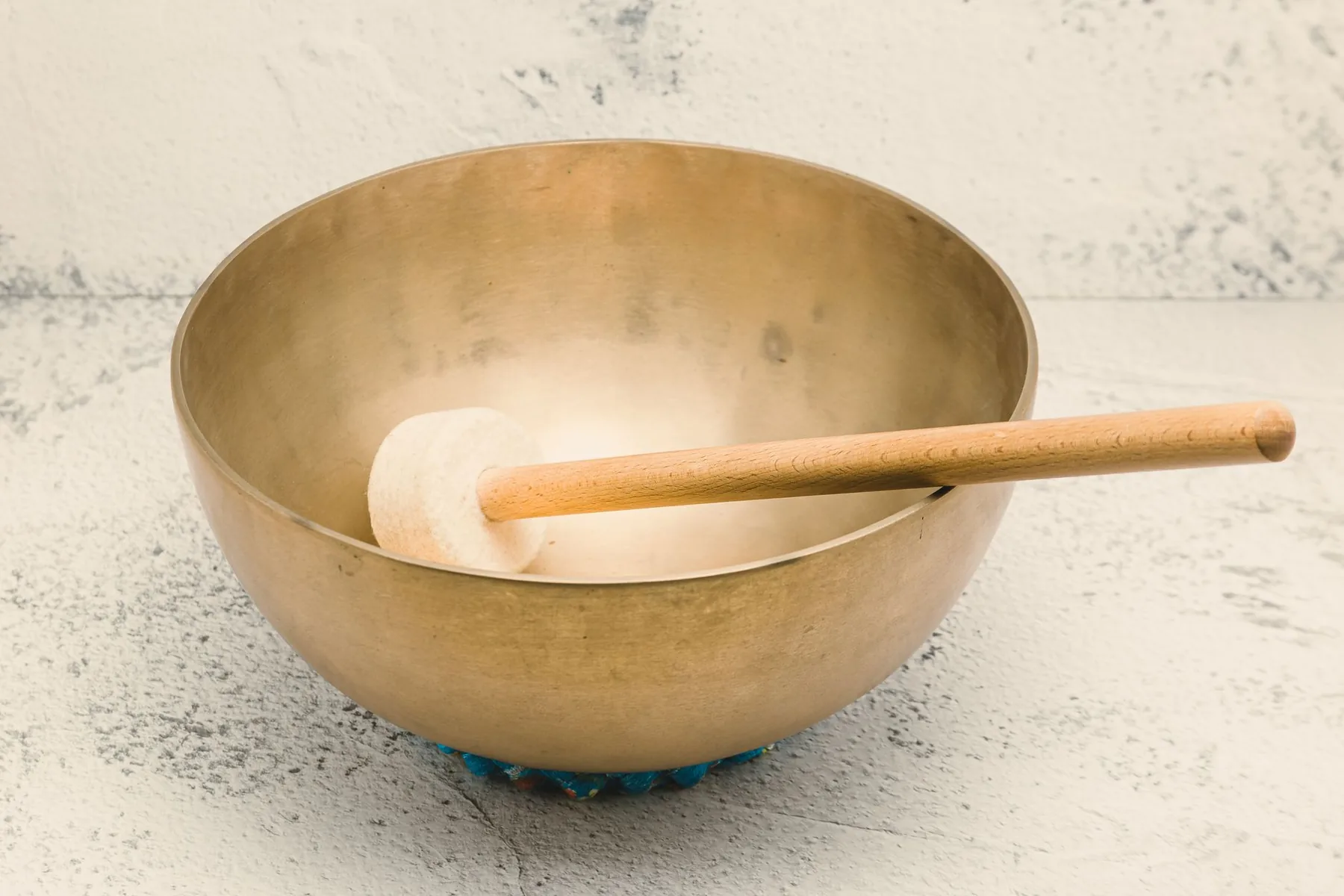
“Test it: a clear strike, smooth rubbing, and clean vibrations in the hand.”
Quick tests before buying
- Gentle strike → clear sound without cutting out.
- Rubbing → stable singing, without jolts.
- Vibrations → perceptible and even in the hand.
Alloys and types
The so-called seven-metal alloy remains a traditional reference point, but not scientific proof of performance. Also compare: hammered (rich harmonics), cast (accessible), engraved (aesthetic), crystal (pure, more intense sound).
| Type | Characteristic | Recommended use |
|---|---|---|
| Hammered | Complex harmonics | Sound exploration, advanced practice |
| Cast | Stable output, accessible price | Learning, regular use |
| Engraved | Aesthetic | Gift, meditative practice |
| Crystal | Pure and penetrating sound | Clear sounds, sound baths |
Reminder: one good-quality piece is better than several average models. To explore the choice further, see this practical guide: how to choose your bowl well.
Accessories and setup for a successful relaxation experience
A simple tool changes both playing ease and the atmosphere of a relaxation session. Choosing between a mallet and a stick changes the color of the sounds and the feeling in the hand.
Which tool for which size and sound result
Practical rule: small models often prefer a thin stick for regular rubbing. Large instruments benefit from a heavier mallet for striking and launching resonance.
The size/tool relationship and comfort in the hand remain essential. Test the grip before a long session.
Support and why to avoid a hard surface
Flat cushion = stability for seated playing. “Donut” cushion = lets the base vibrate and prolongs the song.
A hard surface muffles resonance and creates unwanted noises. Always prefer a suitable cushion.
“The right support lets the instrument speak without forcing the gesture.”
Create a supportive setting
Put your phone on silent, dim the light, and settle into a stable seat. A blanket can be useful if relaxation lowers your body temperature.
Hearing precaution: keep the volume moderate, especially near the face. A strike, even a gentle one, can be surprising.
| Accessory | Use | Benefit |
|---|---|---|
| Mallet | Striking, large models | Launches resonance, clean attack |
| Stick / puja | Rubbing, small models | Control of the song, smooth transition |
| Flat cushion | Stability | Comfort and precision |
| “Donut” cushion | Resonance | Prolongs the harmonics |
To go deeper into technique and use, see this method for making the bowl sing properly. Even with good accessories, posture and holding remain decisive for making it sing without forcing.
Holding the bowl and posture: the basics that change everything
Good holding immediately changes sound quality and session comfort.
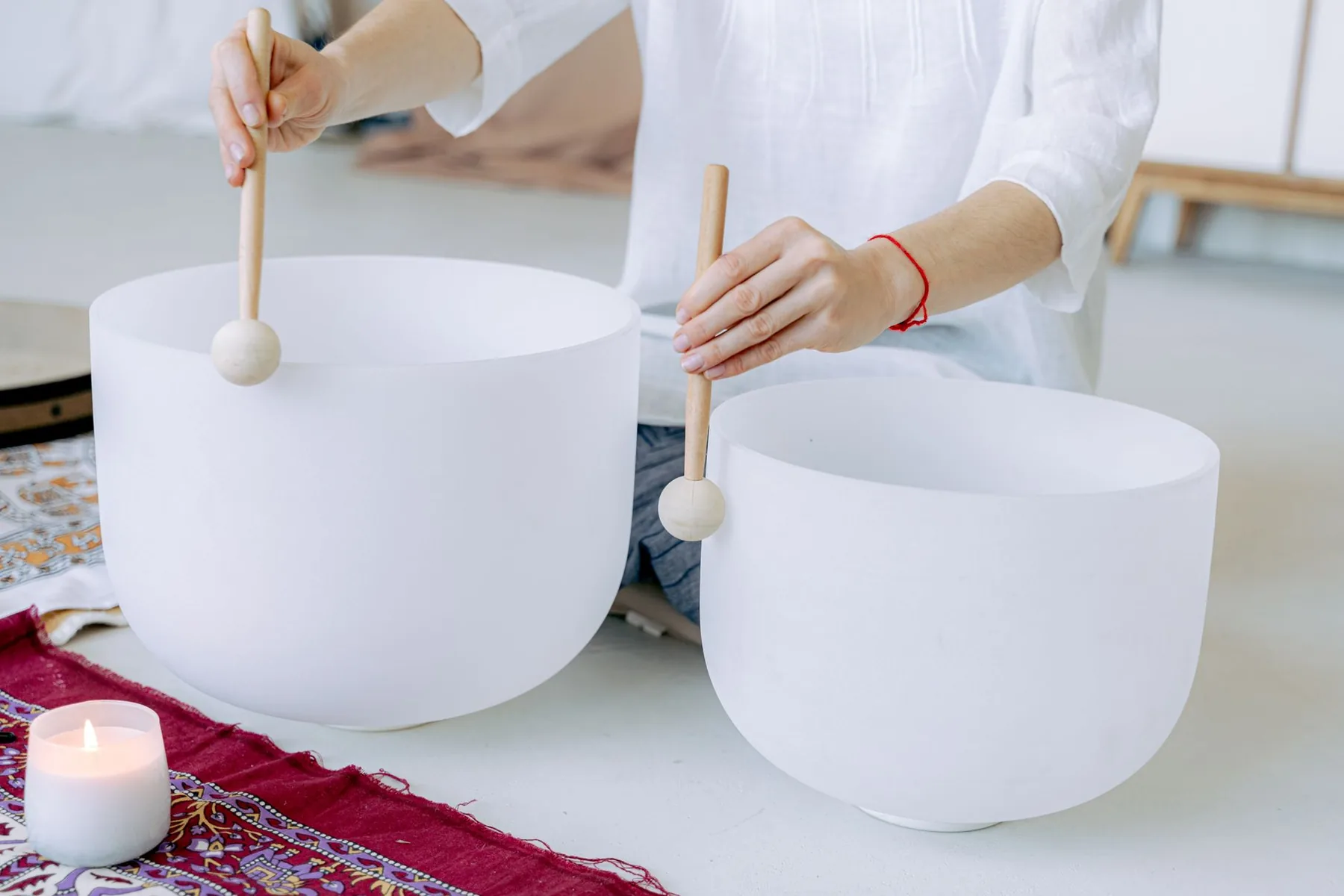
Accessible postures
Sit on a chair, feet on the floor, or sit cross-legged on the floor. Half lotus remains an option if it is comfortable.
Simple criterion: if the position can be held for 10 minutes without pain, it is suitable for meditation and relaxation practice.
Avoid forcing full lotus. Tension increases restlessness and harms the listening state.
Hand position and support
Place the bowl on the open palm, fingers relaxed and slightly spread according to its size. Do not grip the wall: this muffles the vibration.
If your hand gets tired, use a cushion or “donut” cushion to stabilize the instrument and prolong the session.
Holding the mallet
Hold the mallet like a pen, with a flexible wrist. A controlled gesture avoids strikes that are too strong and rubbing that is irregular.
“Three slow breaths, then a very light strike: listen, adjust, then continue.”
| Element | Advice | Benefit |
|---|---|---|
| Chair posture | Feet on the floor, back straight | Stability, easy for 10 minutes |
| Cross-legged posture | Open hips, cushion if needed | Comfort and grounding |
| Hand position | Open palm, loose fingers | Vibrations preserved |
| Mallet | Like a pen, flexible wrist | Control of volume and singing |
Master the basic techniques to make it sound and sing
Gesture precision makes all the difference between a clumsy sound and a real song. Here are the essential techniques to practice regularly.
Striking technique
Aim near the rim, not the base. Give a clean tap and let the mallet rebound for brief contact.
Work on precision by placing the tool a few centimeters from the target point, then make a small swinging motion. Keep the intensity moderate to protect the ear and preserve the note.
Rubbing technique
Place the stick at 90° against the rim. Maintain constant pressure and a regular rhythm.
Initiate the movement with the arm and shoulder, wrist flexible. The absence of jolts stabilizes the vibrations and helps the instrument sing.
Impulse and materials
An initial strike can launch the resonance before moving to rubbing. With experience, it is often no longer needed.
Wood = dry, higher sound. Felt = soft, warm tone. Leather = balance. Choose according to the goal: gentle meditation or transition signal.
The case of crystal
For a crystal bowl, use suitable mallets (plastic or a rougher material). The sound is purer and sometimes intense: play gently.
“Stable angle, even pressure, moderate speed: listen to the harmonics, then let the resonance fade.”
Common problems and quick adjustments when the bowl does not “sing”
When singing turns into clicking, the cause is often mechanical and easy to correct. A singing bowl that “makes noise” produces a click, rattle, or choppy rubbing sound.
Diagnose clicking
This sound appears if the pressure is uneven, the speed too fast, or the contact unstable. Slow the gesture down. Stabilize the pressure and keep continuous contact.
Sound too high
Size plays a role. A small diameter tends toward a higher pitch. Change tools: felt or leather softens the projection, while wood increases the attack. Also adjust playing force to recover better quality.
Sound too loud
Lower the volume with a lighter strike, less pressure while rubbing, or shorter sessions. Practice at a quiet time of day to limit auditory discomfort.
Classic mistakes and symptoms
- Hand too tight → muffled resonance.
- Hard support → unwanted noises.
- Incorrect angle → dropouts.
- Unsuitable tool → unstable singing.
- Insufficient quality → weak sustain.
60-second test process: change one parameter at a time — support → hand → angle → pressure → speed → tool — to isolate the cause. Take your time: a simple, stable sound is better than a powerful but irregular result.
Daily practice: duration, frequency, and structure for a beginner session
Establishing a regular practice quickly changes the quality of sessions. Here are simple reference points to organize your time and gain confidence.
Duration guidelines
Short routine: 5 to 15 minutes to build the habit.
Meditation / relaxation: 10 to 20 minutes for a settled session.
Pace and adaptation
A short daily session is better than a long rare session. If you are tired, reduce the volume, decrease repetitions, and increase silences.
Simple, repeatable sequence
- Centering with 3 deep breaths.
- One gentle strike, then alternating sound / silence.
- Return to stillness before getting up.
Why silences matter
Pauses allow the nervous system to integrate the experience. They refine listening and turn the practice into meditation rather than performance.
Tracking and week 1 goal
Keep a short journal: feeling, duration, ease of making the bowl sing. Record a few sessions to listen to the angle, pressure, and regularity.
“Stabilizing a clean sound and a clear fade-out is better than chasing sophisticated harmonics.”
Reported uses and benefits: meditation, stress, sleep, and energy
Sound, used gently, helps mark a transition between activity and rest.
Meditation: attentional grounding
Many practitioners describe the timbre as a point of support. Listening to the song, observing the end of the resonance, then returning to the sound stabilizes the mind.
Relaxation and stress management
Gentle rubbing, pauses longer than the sound, and slowed breathing support relaxation. Play at low volume to avoid agitation.
Sleep: short protocol
Simple protocol: 3 to 7 minutes, preferably with lower notes if possible. Finish by letting the resonance die away without restarting.
Energy harmonization and chakras
Correspondences are often cited: C = root, D = sacral, E = solar plexus, F = heart, G = throat, A = third eye, B = crown. Use these markers gently and with discernment. Nothing here is medical proof.
Home uses
You can purify a space in the ritual sense, mark a beginning or an end, or layer several instruments.
Practical advice: space out the strikes, listen to the interferences, and leave enough silence to avoid saturation.
| Use | Duration | Advice |
|---|---|---|
| Meditation | 5 to 15 min | Listen to the timbre, pause |
| Stress management | 3 to 10 min | Gentle rubbing, low volume |
| Sleep | 3 to 7 min | Low notes, let the resonance die away |
| Home ritual | 1 to 5 min | Space the bowls apart, mark transitions |
“Effects are reported and depend on context and individual sensitivity.”
To go further, see this practical guide detailing protocols and reference points.
Conclusion
Practical conclusion: prioritize a reliable Tibetan singing bowl, a regular gesture, and plenty of silence. Start with a versatile model (about 15 to 20 cm) and resonance of at least 30 seconds.
Remember the logic: understand the instrument, choose a good bowl, set a simple framework, master striking and rubbing, then build a realistic progression.
Simple buying criteria: clear sound, long sustain, and suitable diameter. Do not neglect the open palm or a “donut” support, and avoid a hard surface.
Checklist: 1 singing bowl, 1 tool, 1 short routine, and more silence than sound at the beginning. To help with choosing, see choose a suitable bowl.
Final note: benefits are built over time. Stay responsible: this practice aims at well-being, without medical promises.