
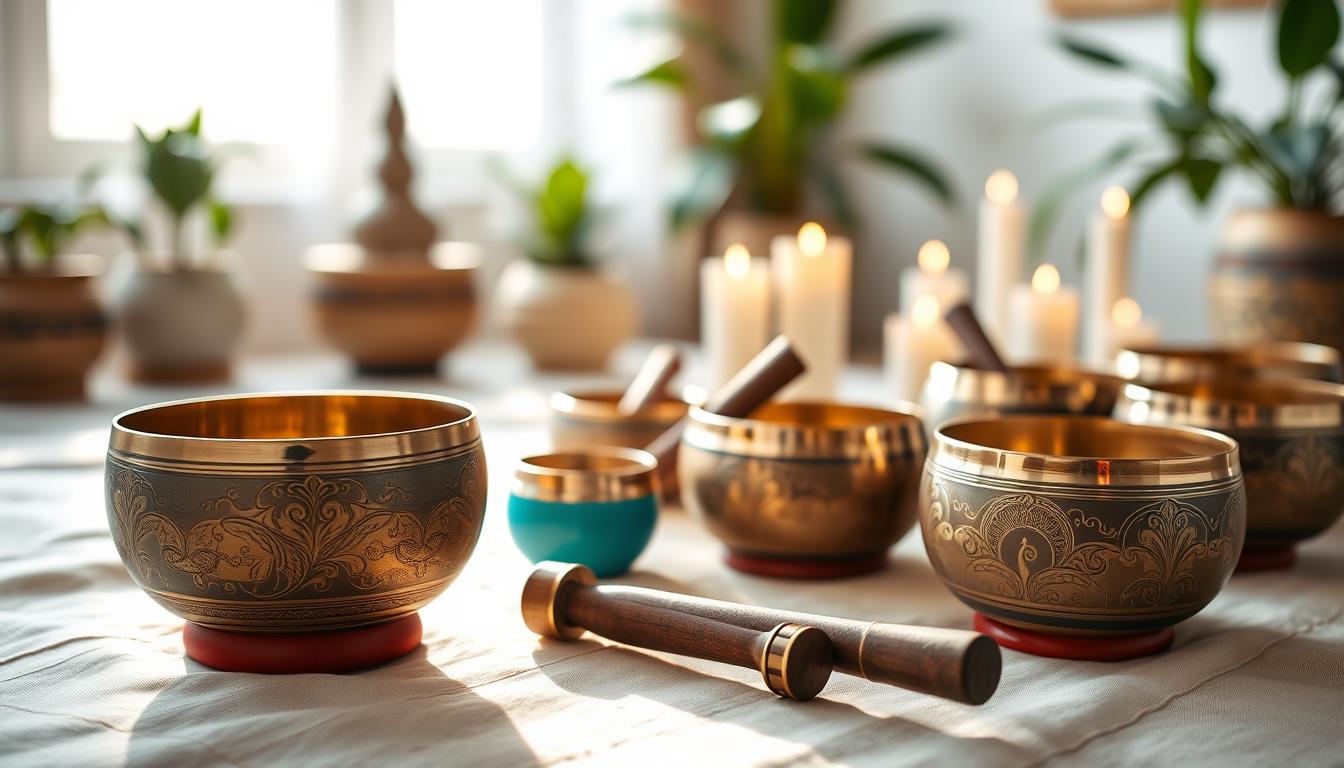
This guide helps you make a real choice to find a bowl suited to your practice: well-being, meditation, or professional use.
Singing bowls differ by material, diameter, thickness, and manufacturing method. These factors influence sound quality, pitch, harmonics, and bodily sensation.
In this article, I offer a simple method: 1) use, 2) material, 3) size/weight, 4) sound quality, 5) note/chakras, 6) frequencies, 7) origin, 8) budget and accessories.
Reassurance: there is no universal singing bowl. The best choice depends on the body, the goal, and the context.
Always test by listening: note sustain, harmonics, and resonance in the body are your reference points. This article also gives practical advice on aesthetics, transport, common mistakes, and price benchmarks.
Why buy a Tibetan singing bowl today: sounds, vibrations, and well-being
The sounds of a Tibetan singing bowl offer concrete support for relaxation and breathing. They can be used during a short session or as part of a regular practice.
What a bowl can bring to relaxation, meditation, and stress management
It is not just a decorative object: it is an instrument whose voice and vibration support concentration and anti-stress routines.
Common uses: sound meditation, yoga, work breaks, end-of-day rituals. These practices can be simple and easy to adapt to everyday life.
Vibration and “vibrational harmony”: what to understand
The idea of vibrational harmony describes the belief that sound and intention help retune the body and energy.
Practitioners present it as a framework; the felt experience remains personal and variable.
What research says: observed effects
An observational study (Goldsby et al.) involving 62 participants (a session of about 60 minutes) reported lower tension, anger, confusion, depression, and anxiety.
The increase in well-being was often more pronounced among beginners, suggesting that sound meditation can be useful for getting started.
| Goal | Suggested size/material | Expected effect |
|---|---|---|
| Soothe | Large metal/bronze | Deep vibration, bodily resonance |
| Energize | Small metal or crystal | High-pitched sounds, energetic stimulation |
| Versatile use | Medium diameter, traditional alloy | Balance between sustain and harmonics |
Coming next: before discussing notes, chakras, and frequencies, you need to define your use clearly. That is what determines the technical choice.
Define your use first: meditation, sound therapy, yoga, harmonizing a space
Start by clarifying where and how you will use this instrument day to day. This step determines the size, sound projection, and durability you need.
Personal use at home: simplicity, comfort, and listening pleasure
For home use, prioritize ease. Choose a bowl that is pleasant to the ear and easy to make sing.
An instrument that is easy to master encourages regular practice and daily enjoyment.
Professional use: transport, note endurance, and volume
In a professional setting, projection and sustain matter. The bowl must hold the note and remain stable during long sessions.
Think about ergonomics: a case, weight, and protection are essential if you travel often.
Specific uses mentioned by practitioners: recharging, vibrated water, space cleansing
Uses such as recharging stones, vibrated water, or space cleansing aim at another kind of energy.
They require a stable bowl, rich in harmonics and easy to control. No practice is judged here; they can be complementary.
- Where will I use it? (home / studio)
- For whom? (me / clients)
- Typical duration? (5 min / 1 hour)
- What effect am I looking for? (soothe / energize / harmonize)
Plan for accessories: mallet, felt, cushion, and carrying case shape the way you play and learn. Once your use is clear, you will know better how to choose a Tibetan bowl between metal and quartz using objective criteria.
Tibetan singing bowls: how to choose the right model by material
The material of a bowl defines both its timbre and its practical use.
Two major families stand out clearly: traditional metal instruments and crystal quartz models. Shape and manufacturing influence the color of the sound and how easy it is to tune.
Alloy and hammered metal
Metal instruments often come from workshops in Tibet, Nepal, or India. What you are buying is craftsmanship: hand hammering, engravings, and a rounder sound signature.
This type of instrument uses several metals and an ancient alloy. It produces deep vibrations and enveloping resonance.
Crystalline quartz: precision
Quartz has been manufactured industrially since the 1980s. It offers targeted tuning and more crystalline sounds.
Consistent manufacturing makes note sustain easier for sound therapy.
Composition and advice
The legend of the “7 metals” (gold, copper, silver, etc.) remains an indicator, not an absolute rule. Bronze and brass alter the color; composition influences the felt experience.
Practical advice: if you are looking for tradition and a living object, choose metal. If you want frequency precision, prefer quartz.
Next: size, diameter, and weight will deeply change the sound experience.
Size, diameter, and weight: the direct impact on sounds and practice
The size of a bowl radically changes its voice and the way you use it.
Small diameter: bright and energizing
A small diameter produces higher-pitched sounds and an energizing effect. These instruments are easy to carry and fit well into a short routine.
Large diameter: depth and relaxation
A larger diameter moves toward lower notes. The vibration is more intense and supports relaxation during sound baths or long sessions.
Weight and ergonomics: playing comfortably
Weight increases quickly with diameter; a bowl can exceed 1 kg, and holding 3 kg for a long time becomes tiring. Always test the balance and comfort in your hand.
“A bowl that is too heavy often ends up in the cupboard, even if it sounds good.”
| Use | Recommended size | Advantage |
|---|---|---|
| Transport / awakening | 8 to 11 centimeters | Light, bright, practical |
| All-purpose / gift | 12 to 17 centimeters | Good compromise between handling and sound richness |
| Long sessions / sound baths | 18 centimeters and above | Deep lows, strong vibration |
Practical advice: in a shop, simulate your use (standing, seated, on the move) to confirm comfort; otherwise, prioritize a cushion or stand.
Sound quality: how to assess harmonics, note sustain, and vibrations
A good instrument reveals its personality from the first strike: listen to its sustain and harmonics.
What a good instrument should produce
Strike gently with a padded part. Listen to the rise of the harmonics and the duration of the note.
Criteria: full resonance, tonal complexity, long sustain, and a pleasant vibration that fills the space.
Warning signs
A hollow, harsh metallic, monotonous sound, or one that dies out too quickly, indicates low quality.
Avoid an instrument that gives a sense of dissonance despite a correct strike.
The body test
Place the instrument near your hands or torso and listen with your body. Sensations (tingling, relaxation, grounding) are useful clues.
Also observe your breathing: if it calms down, the effect is positive for you.
Struck vs. rubbed: two ways to explore
Some pieces sing better when rubbed, while others shine when struck. This is not an absolute judgment of quality.
Practical advice: test several mallets (felt, leather, wood). The tool strongly changes the sounds and the perception of vibrations.
| Simple test | What it reveals | Action |
|---|---|---|
| Strike with felt | Amplitude and sustain | Prefer it if the sustain is long |
| Rub with a stick | Harmonics and stability | Check the gradual rise of the sound |
| Body listening | Effect felt in the body | Choose according to your taste and comfort |
To deepen your listening to sounds and techniques, compare several instruments before buying.
Musical notes and chakras: how to choose without making a mistake
Associating a note with an energy center helps structure a session, but that link deserves nuance.
Why the note draws attention: in the West, a frequency serves as a reference point for working on a specific chakra. This helps set an intention during practice.
Common correspondences
Here are associations often used, without dogmatism:
| Area | Note (example) | Intended effect |
|---|---|---|
| Muladhara (root) | C | Grounding, stability |
| Anahata (heart) | A | Openness, empathy |
| Ajna / Crown | B / D | Mental clarity, subtle listening |
Point of caution
A Tibetan bowl does not emit a pure frequency: it produces harmonics. The effect spreads through the whole body and often goes beyond the single chakra being targeted.
Pragmatic buying approach: if you have only one instrument, prioritize sound quality and how it feels. The note becomes a bonus.
“For targeted work, build a set gradually rather than expecting perfection from your first purchase.”
To go further, read this article on notes and chakras and test several sounds to choose a bowl according to your body and goals.
Frequencies 440 Hz, 432 Hz, 528 Hz: useful or marketing?
Understanding what “440 Hz” means helps you avoid marketing promises. 440 Hz corresponds to A4 = 440 oscillations per second, a tuning standard used in contemporary music.
432 Hz and 528 Hz are sought by some users for supposed harmony or perceived effects on energy and perception.
However, many instruments are sold without any real tuning precision. “432 Hz” or “528 Hz” labels can be a sales argument if the buyer does not ask for proof.
Why prefer quartz if frequency is crucial
Buying rule: if you work with a musical or energetic protocol that requires a precise frequency, choose a quartz bowl.
Quartz is manufactured industrially and can be calibrated precisely. Measurements are therefore more reliable for demanding uses.
Why metal varies
A metal instrument is the result of craftwork: hammering, thickness, temperature, and wear all alter the note.
These variations make it difficult to guarantee a pure frequency down to the oscillation, even though the sound and vibration can be very rich and appreciated.
Anti-marketing advice
- Ask for a measurement (recording or certificate) if frequency is a non-negotiable criterion.
- Test the instrument with your ear and your body: perception of sounds and vibrations can matter more than the label.
- To learn more about the debate around 432 Hz, read this article: Why the 432 Hz frequency appeals.
Authenticity and origin: recognizing a real Tibetan bowl and avoiding counterfeits
The true origin of a bowl is often revealed in its details and sound.
Visual clues: a handmade instrument shows irregularities, hammer marks, and subtle variations in shape. Cast pieces look too uniform and repeat the same engravings.
Origin and ethics
A country printed on the label (Nepal, Tibet, India) does not guarantee traceability. Prefer a seller who is transparent about origin and production conditions.
Composition and materials
Check the composition and the alloy. Very cheap metals, such as some steels, can alter sound quality. A credible and documented alloy increases the chances of good quality.
Sellers and guarantees
Require proof of origin, real photos, an audio recording, and a return policy. A short guarantee or lack of reassurance are warning signs.
False promises
Claims such as “antique,” “Full Moon,” or precise dating are often unverifiable. It is better to choose a quality new bowl than a supposedly old one without proof.
- Examine coherent irregularities and hammer marks.
- Listen to the uniqueness of the sound: harmonics and sustain.
- Avoid sellers offering many identical instruments.
- Ask for the composition, alloy, and an audio recording.
| Criterion | Handmade | Cast / Industrial |
|---|---|---|
| Appearance | Variations, hammer marks | Uniform, repeated screen printing |
| Sound | Harmonic richness, sustain | Often monotonous, weak sustain |
| Traceability | Often provided by the artisan | Vague or multiple origin |
Practical advice: for more reassurance, read a dedicated page on recognizing an authentic instrument via this link: recognize a real bowl.
“A new, traceable, quality bowl is often better than an ‘antique’ with no proof.”
Budget, price, and accessories: what you are really paying for
The cost reflects the material, craft time, and sound control. A metal instrument often remains affordable for beginners, sometimes under €50. Quartz clearly starts higher: often expect around €100 for a small model.
Why two apparently similar pieces can cost very different amounts: hand engravings, polishing, alloy quality (brass, bronze), note stability, and documented origin.
Accessories and mallets
A good mallet changes everything. Wood, leather/suede, felt, or fabric produce distinct sounds. Striking with a padded face supports a full sound and rich harmonics.
- What your budget covers: raw material, craft time, sound control, finishes.
- Buying logic: prioritize satisfying note sustain and vibration rather than heavy decoration.
- Ergonomics: the more size and weight increase, the more price and difficulty of use rise.
| Item | Indicative range | Impact |
|---|---|---|
| Small metal model | Less than €50 | Accessible, good entry point |
| Small quartz model | Around €100 and up | Precise tuning, costly |
| Craftsmanship / finish | +€30 to +€200 | Hand engravings, Jambati, better sonority |
| Quality mallet | €10 to €60 | Transforms sound expression |
“First buy an instrument that holds the note; add a second mallet to broaden your possibilities.”
Conclusion
In conclusion, prioritize the sound experience over marketing promises.
Simple summary: first define your use, choose the material (metals or quartz), select a suitable size and diameter, then validate the quality by listening and by feel.
A good Tibetan bowl is recognized by its note sustain, its harmonics, and the vibration that speaks to your body. For a first purchase, a medium-sized metal singing bowl (about 12 to 17 centimeters) often remains the most versatile choice.
Points of caution: check the origin, the uniformity of the pieces, “antique” claims, and the return policy. Test several instruments and mallets before buying.
Review each criterion, compare 3 to 5 models, and buy from a transparent seller (audio/video proof and returns). To complete your approach, read this practical guide: choosing a Tibetan singing bowl.