
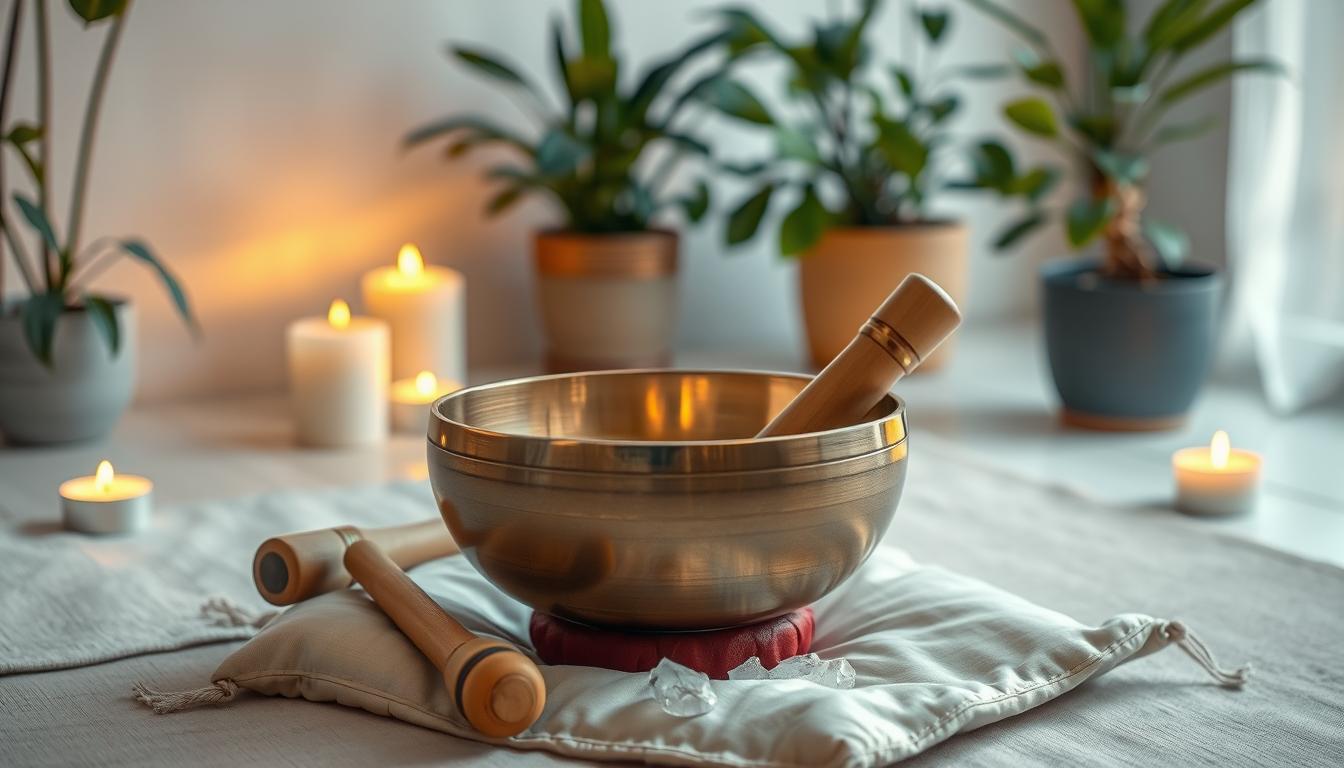
Goal of this guide: explain, step by step, how to use a singing instrument to purify objects and places. This guide stays practical and realistic: little equipment, short sessions, and results that feel different from one person to another.
You will learn why this tool works through vibrations, when to practice, and how to make it sing. The text also details methods for stones, jewelry, or pendulums, then a room-by-room approach for the home.
Typical duration: from a few seconds to a few minutes. Minimal equipment: Tibetan bowl, mallet. Choose a quiet place and adapt the technique to the size of the bowl and the object being treated.
Caution: these rituals belong to well-being practices. They do not replace medical advice or treatment. Effects vary from one person to another.
Follow the order of the sections to move from theory to practice without skipping steps. Simple tips and key ideas such as intention, recharging, and energetic hygiene will be introduced.
Why use a Tibetan singing bowl for purification and energy cleansing
The principle is simple: the singing bowl produces sound waves and vibrations that act on the atmosphere of an object or a place. In current practices, these waves are used to lighten what people perceive as tension or negative energies.
How vibrations help release accumulated charge
When the bowl is sounded, the vibrations activate the surrounding space and the targeted object. Practitioners report a feeling of clarity, as if retained information had softened.
This action remains subjective, but it is used to reduce the buildup of elements perceived as heavy. The effect is often felt immediately: a lighter atmosphere, a sense of relief.
Purify and recharge in one practice
Practical advantage: unlike separate methods, the singing tool often combines release and recharge in the same gesture. This simplifies the routine for stones, jewelry, or divination tools.
What can be cleansed
- Lithotherapy stones and minerals.
- Jewelry (bracelets, necklaces) and pendulums.
- Indoor spaces: a room, apartment, or house.
On an object, the action is intended to be focused and quick. For a place, the goal is a broader and more even diffusion of the waves. Regular hygiene: the more an object or space is used, the more frequent intervention helps maintain balance.
In the next section, we will see when and how often to practice so you do not act at random.
When to do energy cleansing with a Tibetan bowl
Knowing when to intervene helps keep your objects and your place balanced without excess. Simple rule: aim for a weekly routine if the object is worn or used a lot. If use is occasional, once a month is enough to maintain a neutral baseline.
Adapt the rhythm according to use
Lengthen or shorten the time between two interventions according to the intensity of use, the number of people handling the object, and your own feeling. If a piece of jewelry feels “heavy” or the atmosphere feels charged, act sooner.
Times when you should act immediately
- Arrival of new stones or a second-hand purchase.
- An object lent to another person: cleanse it when it comes back.
- After an intense treatment or a session with stones or a pendulum.
- Strong emotional periods (illness, grief, breakup, conflict).
- Before or after moving house, or after an argument at home.
“It is often more useful to act at the right time than to multiply interventions.”
Before making the Tibetan bowl sing, prepare the space: quiet, ventilation, and a clear intention noticeably improve the quality of the ritual. For practical methods, see this guide on recharging stones.
Prepare your purification session for effective use
Before playing, set up a clear space and define a precise intention to maximize the impact of the session.
Create the right conditions
Quickly tidy the area, turn off notifications, and take three breaths to center yourself. A short intention guides the action: for example “I purify and recharge these stones”.
Ventilate the space
Open the windows for a few minutes before the session and, if possible, during it. Fresh air helps symbolize the release of stagnant energies. For room cleansing, allow a slight flow of air.
Set up the instrument
You can hold the object in your hand for a short, mobile practice, or place it on a cushion or clean cloth for better resonance. Check that the surface does not muffle the sound.
Choose a mallet or stick
The choice of mallet changes the result: some mallets emphasize the attack (strike), while others encourage the gradual rise of the singing tone through friction. Adapt the way you strike according to the effect you want.
| Action | Option | Expected effect |
|---|---|---|
| Setup | In the hand | Mobility, short use |
| Setup | On a cushion/cloth | Stability, better resonance |
| Tool | Hard mallet | Clear attack, immediate impact |
| Tool | Soft stick | Extended friction, deep singing tone |
Check that the object to be treated is physically clean and stable. When everything is ready, you will move on to the basic technique: strike + friction. To go deeper into how to use a bowl, consult this practical guide on making a bowl sing easily.
Making a Tibetan bowl sing: the basic technique (strike + friction)
The foundation for obtaining a continuous sound rests on two complementary gestures: a clear impulse followed by steady friction. These two steps start and amplify the vibrations until a stable singing tone is obtained.
Give the impulse: a clean mallet strike
Make sure your posture is stable. Place the bowl on a cushion or hold it gently in your hand. Hold the mallet without tension, with a flexible wrist.
Strike the wall (not the sharp rim) with a clean, controlled tap. This impulse “awakens” the vibrations and prepares the singing tone.
Rub the rim smoothly and regularly
After the impulse, rub the outside rim with constant pressure. Use a fluid movement and moderate speed to bring up the sound.
If the sound skips or crackles, reduce the pressure, slow down, and find the right contact angle between the mallet and the metal.
Recommended direction of rotation and steadiness of the gesture
Preferably turn clockwise. This reference helps you stay consistent, but the real key remains the regularity of the movement.
- Practice: repeat 2 to 3 strike + friction cycles for a few minutes to adjust the angle and pressure.
- Practical reference: consistency matters more than force.
| Gesture | Posture | Effect | Tip |
|---|---|---|---|
| Impulse | Bowl on cushion or in the hand | Starts the vibrations | Clean strike, not on the rim |
| Friction | Flexible wrist | Raises the singing tone | Constant pressure, moderate speed |
| Stability | Straight back, slow breathing | Continuous, clean sound | Slow down if it crackles |
| Practice | Short sessions | Better control | 2 to 3 cycles of a few minutes |
Once the sound is stable, you can make the bowl sing to treat an object “inside the bowl” or around it, depending on its size and fragility.
Tibetan Bowl: Purification and Energy Cleansing, Instructions for Use
Learn a quick method for treating a mineral and a gentler alternative for fragile pieces.
The “inside the bowl” method
Step by step: place the stone, bracelet, or pendant in the bowl. Give an impulse, then rub the rim steadily.
Time reference: about 20 seconds for a small bowl and a sturdy object. Finish with one last clean strike, then wait for silence before removing the object.
The “around the bowl” method
For large bowls or fragile minerals, place the bowl on a cushion and arrange the stones around it.
Make it sing for about 1 minute to diffuse the sound without subjecting the object to overly strong vibration.
Several stones at once
Yes, if the bowl size allows it. Avoid mixing incompatible families; if in doubt, treat them separately.
End of ritual and micro-routine
Finish with one last strike, let silence settle, then calmly remove the objects. Move from one object to the next while keeping the same intention.
| Method | Placement | Indicative duration | When to use it |
|---|---|---|---|
| Inside the bowl | Object placed in the center | ~20 s | Small sturdy objects |
| Around | Minerals arranged around it | ~1 min | Large bowls, fragile stones |
| Multiple | Grouped if there is enough room | 20-60 s depending on size | Small stones, bracelets |
For more details on the technique, see how to make the bowl sing in practice.
Purifying your home with a Tibetan singing bowl: a room-by-room ritual
A room-by-room ritual helps clear heavy atmospheres and bring a clearer feeling back into the home.
Goal: symbolically move stagnant energies outward to regain a lighter life.
Logical order: start with the room farthest from the front door. If you have several floors, begin with the highest one. Progress toward the exit so you do not recharge a space that has already been treated.
Room-by-room method
Stand in the corner opposite the door. Sound the singing bowl, then sweep each corner from top to bottom. Direct the sound toward the door, as if guiding a current outward.
Strike firmly enough to fill the room without hurting your hearing. Repeat 2 to 3 times per corner. Listen to the reverberation and sense when the space feels clearer.
Hallways and passage areas
Work lengthwise while moving forward slowly. Direct the sound toward the front door to create a continuous flow.
| Step | Action | Reference point |
|---|---|---|
| Preparation | Ventilate beforehand | Windows open 5-10 min |
| Start | Farthest room / upper floor | Corner opposite the door |
| Treatment | Sweep corners top to bottom | 2-3 passes per corner |
| Closing | Gratitude at the door, closing the windows | Feeling of a reset space |
Repeat this ritual at each change of season, after a major event, or before moving in. These tips support regular and useful use of the singing bowl to harmonize your living space.
Choosing the right Tibetan bowl for purification: size, tone, metals
The choice of a sound instrument directly affects the reach of the sound and the intended use.
Small bowls (about 10-15 cm) produce higher-pitched sounds. They are well suited to stones and jewelry because the action remains focused.
Large bowls (20 cm or more) offer deep sounds that fill a room. For a living space, aim for a note close to the heart chakra, often identified around F.
Materials: metal alloy vs. crystal
Metal alloy bowls, often hand-hammered, provide a rich timbre and varied harmonics. Quartz crystal offers a purer, longer sound, but with a different felt quality.
“A hand-hammered instrument often reveals a more complex harmonic palette.”
| Criterion | Recommended use | Numerical reference |
|---|---|---|
| Small size | Stones, jewelry | 10-15 cm |
| Large size | Whole room | 20 cm or more (F ~87 Hz for ~30 cm) |
| Material | Metal alloy vs. crystal | Harmonics vs. purity |
If you are unsure, test before buying. For a practical buying guide, see this guide to choosing a singing bowl.
Cleanse and recharge your singing bowl to preserve its effectiveness
After each session, it is useful to return the instrument to a neutral state. Regular care preserves the clarity of the sound and sensitivity to the practices.
Why the instrument can become charged
If you use the singing bowl or Tibetan bowl to treat objects, places, or people, some practitioners find that it stores traces.
These traces can make the timbre less clear and reduce the perceived effect during a treatment.
Recommended frequency
Ideally, do a brief recharge after each use. After an intense session (home, treatment, emotional period), do it promptly.
Recharging methods
- Sun: expose for about 20 minutes (if the sky is gray, about 40 min). Watch UV exposure for metal or crystal: no prolonged exposure.
- Full moon: leave overnight in moonlight. Protect it from moisture (sheltered ledge, indoors near a window).
- Flower of Life / Tree of Life: place the bowl for several hours on the symbol (around 12 h) to rebalance the form and resonance.
- Smoke cleansing: pass smoke around it for 10 minutes with white sage, myrrh, frankincense, benzoin, or storax.
Times to avoid and caution
Avoid the balsamic moon if you follow lunar markers: its energy is often considered unstable.
These practices belong to traditions and well-being; they do not have universal scientific validation.
Keep a measured approach and never substitute these gestures for medical advice.
| Method | Duration | Precaution |
|---|---|---|
| Sun | ~20 min (up to 40 min if cloudy) | Avoid prolonged exposure, protect crystal |
| Full moon | One night | Sheltered from rain and humidity |
| Flower of Life / Tree of Life | ~12 h | Stable surface, regular symbol |
| Smoke cleansing | ~10 min | Ventilate after use, avoid direct contact with embers |
Conclusion
To conclude, remember the essentials: quiet, ventilation, and clear intention before making your instrument sing.
Summary instructions: strike then rub, choose “inside the bowl” or “around” according to fragility, finish with silence and put things away gently.
This guide covers caring for objects (stones, jewelry, pendulums) and the room-by-room ritual for the home. Allow a few dozen seconds for an object and about 1 minute around a large bowl, adapting according to how it feels.
Care: cleanse and recharge the instrument regularly and avoid overly strong vibrations on fragile minerals. To learn how to use a bowl step by step, consult this practical link: use a bowl step by step.
Try a weekly or monthly routine, note the changes in your life, and leave a comment with the size of your bowl, the objects treated, or your questions to enrich this article.