

A simple guide to adding a short, soothing sound ritual before bedtime. In France, nearly 40% of adults report sleep problems. Studies (2014, 2016) show that sound sessions can reduce stress and certain markers of tension.
This article is for people whose sleep onset is delayed by rumination or physical tension. The editorial promise is clear: a routine of a few minutes centered on sound, vibrations, and breathing to make sleep easier.
Here you will find: why it helps, the scientific evidence, the theory of brain waves, simple instructions, playing techniques, and advice on the right environment. This approach is complementary and does not replace medical advice in cases of persistent insomnia.
Key tip: regularity often matters more than a long, occasional session. Start tonight with a short routine that suits you.
Why the Tibetan singing bowl helps you fall asleep when stress delays sleep
A tense mind keeps the body on alert; simple sound stimulation can reverse that reflex.
Context in France and the appeal of natural solutions
Nearly 40% of French people report difficulty falling asleep. Non-drug routines are appealing because they offer a safe and accessible option.
Vibrations, body sensation, and calm
Vibrations can be felt in the palm, chest, or abdomen depending on proximity. This “enveloping” effect helps the body leave a state of hypervigilance.
A steady sound as an anchor to slow the mind
A regular sound acts as a point of attention. When attention returns to the tone, rumination loses speed and stress decreases.
| Effect | Mechanism | Expected result |
|---|---|---|
| Body sensation | Tactile vibrations | Relaxation of the shoulders and jaw |
| Nervous-system regulation | Parasympathetic activation | Greater resting state |
| Attentional anchoring | Steady sound | Less rumination |
Tip: a gentle, steady gesture is enough; simplicity matters more than technique. To learn more about sleep disorders and complementary approaches, see specialist resources.
What studies say about relaxation and lower stress
Several recent studies examine the impact of sound on stress and the quality of rest.

University of San Diego study (2016)
The 2016 study reports that after a singing bowl session, participants felt a reduction in stress and anxiety. Perceived well-being improved, even though the duration of the effect varies across reports.
Results reported in 2014
Earlier research (2014) documents a decrease in physiological markers of tension. In particular, lower blood pressure was noted, and sometimes lower cortisol depending on the protocol.
Why results vary
The effects differ according to personal sensitivity, instrument quality, technique, and session regularity.
Practical advice: favor short, regular practice (10 to 15 minutes) rather than long, isolated attempts. This simple habit maximizes progressive benefits.
| Aspect studied | Common result | Limits |
|---|---|---|
| Perceived stress | Lower after a session | Varies by individual |
| Physiological markers | Lower blood pressure | Protocol and instrumentation |
| Well-being | Reported improvement | Temporary effects |
Important: these studies provide reference points and do not rule out medical advice if insomnia is chronic or associated with other health problems.
Alpha waves and the transition to sleep: understanding the mechanism
Before bedtime, the brain changes rhythm: it gradually leaves agitation behind and enters a slower register.
Alpha waves vs. beta waves: what changes
Beta waves correspond to fast mental activity, reasoning, and rumination.
By contrast, alpha waves (about 8 to 12 Hz) indicate a relaxed state and broader attention.
Toward theta: the “doorway” to drowsiness
The transition toward theta waves marks drowsiness and deep meditation. This is often the moment when the mind lets go of repetitive thoughts.
A steady, harmonic sound acts like an attentional metronome. Vibrations reinforce the feeling of release and support the shift from beta to alpha waves, then toward theta.
| Phase | Dominant rhythm | What it produces |
|---|---|---|
| Active wakefulness | Beta | Concentration, rumination |
| Relaxation | Alpha waves | Release, broad attention |
| Drowsiness | Theta | Access to deep meditation, pre-sleep |
Practical instruction: choose a steady sound, moderate volume, and constant rhythm. Do not expect an instant effect: this tool supports the neurophysiological transition toward relaxation; it does not mechanically guarantee sleep.
Tibetan singing bowl for sleep: how to use it at night
Before striking the bowl, a quiet space and a settled intention greatly increase the session’s effectiveness.
Atmosphere and preparation
Dim the lights and turn off notifications. Avoid screens 15 to 30 minutes before bedtime.
Ideal temperature: around 16 to 18°C. Create an atmosphere that signals rest to the brain.
Bowl position and hand comfort
Place the instrument on your palm, hand open, shoulders relaxed. If your hand becomes tense, use a cushion.
Breathing rhythm and method
Inhale calmly, then exhale 1.5 to 2 times longer. Pair each sound with an exhale.
Duration and simple sequence
- Sit comfortably and set the intention to “slow down.”
- Produce a soft sound and listen until silence.
- Repeat for the chosen duration.
Beginners: start with 5 to 10 minutes. Then aim for regular 10- to 15-minute sessions before bedtime.
End of the session
Let the sound fade naturally. Stay in silence for 1 to 2 minutes, then go to bed without picking up your phone again.
| Step | Recommended duration | Goal |
|---|---|---|
| Preparation | 2 to 5 minutes | Signal the shift into rest |
| Active practice | 5 to 15 minutes | Establish relaxation and slow the mind |
| Ending and silence | 1 to 2 minutes | Consolidate the effect before sleep |
Mini express protocol: 3 gentle strikes + 6 slow breaths + silence. Useful on rushed evenings.
To deepen your practice and choose a suitable instrument, see our guide to Tibetan singing bowls for sleep.
Techniques for making the bowl sing: striking and rubbing without squeaking
Mastering a few simple gestures clearly improves the purity of the sound and the resonance. Two main methods are enough: gentle striking and rubbing the rim.
Gentle striking for a pure sound and clear resonance
Strike near the rim with a controlled, light gesture. A moderate attack produces a stable, non-aggressive sound, ideal in an end-of-day ritual.
Rubbing the rim to prolong the vibrations
Move the mallet in a circular path against the rim. Use a steady speed and constant pressure to avoid squeaking.
Wood or felt mallet: impact on sounds
A wooden mallet gives a sharper attack and clearer tones. Felt offers a softer, rounder attack. At night, favor felt.
Gestures that disturb resonance
- Gripping the handle too tightly.
- Varying the pressure or angle.
- Speeding up abruptly or striking too hard.
Learning exercise: 5 spaced strikes (let the sound die away), 30 seconds of steady rim rubbing, then complete silence.
Practical note: the quality of the sounds and waves matters more than power. To learn more and deepen your method, see our practical guide.
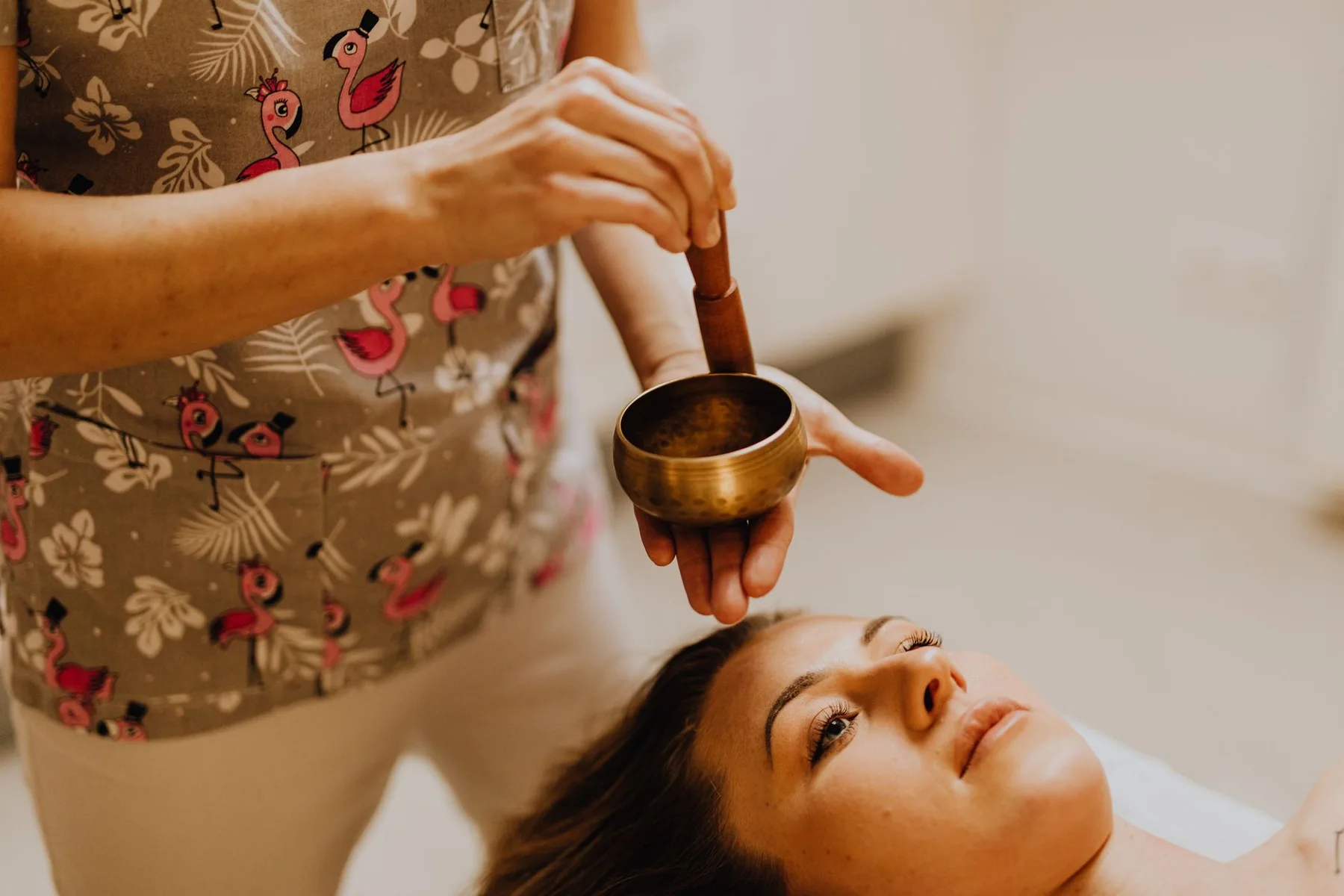
Create an environment that supports falling asleep with your Tibetan singing bowl
Preparing the bedroom is as important as the practice itself: the environment guides the body’s response.
Temperature: keep the room around 16 to 18°C. A drop in temperature helps the thermoregulatory decrease needed for sleep. A bedroom that is too warm encourages micro-awakenings.

Quick checklist
- Very soft light, blackout curtains, or closed shutters.
- Phone out of reach and notifications turned off.
- A tidy space to reduce mental load.
Managing sound
Favor relative quiet. If irregular noises are disruptive, discreet white noise can mask disturbances without stimulating you.
Place your bowl at a comfortable distance from the bed and play before slipping under the duvet. Keep one minute of silence after practice to let the effect settle in.
| Element | Action | Purpose |
|---|---|---|
| Temperature | 16 to 18°C | Support the drop in body temperature |
| Light | Very dim or darkness | Enter the resting state |
| Sounds | Low volume / white noise if needed | Avoid auditory stimulation |
Tip: at night, volume is simple: less is often better. A coherent environment strengthens the ritual and increases the well-being linked to the sounds of the Tibetan singing bowl.
Evening ritual: making the bowl part of a lasting relaxation routine
A few minutes of practice each evening creates a real anchor. The same sound, paired with steady breathing, teaches the body and mind that rest is approaching.
Simple, repeatable format
Standard sequence: 2 to 3 minutes of slow breathing, 6 to 10 gentle spaced strikes, then 2 minutes of total silence. This short routine promotes relaxation without requiring much time.
Variations according to energy
- Very agitated: 5 minutes of cardiac coherence before practice.
- Physically tense: 5 minutes of gentle yoga to release tension.
- Want deeper meditation: add 3 minutes of visualization after the strikes.
Measuring how long
Start with 5 to 7 minutes. If the sessions bring benefits, gradually increase toward 10 to 15 minutes. Adjust according to how you feel.
In case of nighttime waking
Mini ritual: one gentle strike, three long exhales, then silence. No screen. This tactic limits mental reactivation.
Adaptation for children
Shorter duration, low volume, and a reassuring gesture. Use the Tibetan singing bowl as a stable end-of-day signal. Listen to the child’s state and shorten the practice if needed.
Choosing the right Tibetan singing bowl for sleep: size, metals, and tone
Choosing a suitable instrument profoundly changes the experience. For use before rest, favor a rather low and stable tone. Low sounds are perceived as more enveloping and less stimulating than high ones.
Size and weight influence pitch: a larger, thicker bowl produces more sustained lows and longer resonance. This makes it easier to maintain the sound and the anchoring effect.
Alloys and “seven metals”
Some artisans mention the “seven metals” (copper, tin, zinc, iron, silver, gold, nickel). This is a commercial tradition: composition influences tone, but it does not provide magical power.
Testing resonance before purchase
Simple in-store protocol:
- 1 gentle strike: listen to the length and regularity of the sound.
- Check for the absence of discordant notes or aggressive beats.
- Feel the vibration in your hand and test rim rubbing for harmonic richness.
| Criterion | Positive indicator | Action |
|---|---|---|
| Tone | Low, stable | Choose a large/thick model |
| Resonance | Long, rich harmonics | Favor sustain |
| Quality | Even sound without squeaking | Check origin and composition |
Spotting counterfeits and maintenance
Beware of products with unclear composition; avoid questionable alloys that may contain lead. Demand transparency about origin.
Maintenance: clean with a soft cloth and avoid abrasives. Dry completely and protect the rim, the playing area, to preserve resonance. Store the instrument on a cushion, away from impacts and moisture.
To deepen your choices, see our practical guide to singing bowls.
Listening to Tibetan singing bowl recordings: when it helps, when it limits the experience
A well-chosen audio file lets you test the practice without investing in an instrument. It is practical when traveling, in a shared bedroom, or to quickly establish an evening routine.
Advantages: starting without a purchase, repeating the same sequence, and launching a session within minutes. Listening can support well-being and create a sound anchor before bedtime.
Limits: the lack of tactile vibration changes the experience. Compressed recordings often weaken the low frequencies; the result can lose the “cocoon” effect produced by bass tones.
Practical audio tips
- Moderate volume: avoid listening too close to the ears.
- Equipment: prefer speakers or headphones that reproduce bass well.
- Format: favor high-fidelity files without saturation.
“A good recording and faithful playback make a major difference for relaxation.”
| Use | Advantage | Limit |
|---|---|---|
| Practical test | Start without an instrument | No body vibration |
| Travel | Mobile routine | Speakers weak in bass |
| Short routine | Launch 10 to 15 minutes | Quality varies by file |
Use audio for 10 to 15 minutes, practice slow breathing, then turn it off and remain in silence before going to bed. To enrich your quiet moments, also discover soothing religious songs.
Precautions, contraindications, and common mistakes to avoid at night
Before adding this instrument to your routine, it is useful to identify situations that call for caution.
At-risk profiles
Ask for medical advice if you have: epilepsy, implanted electronic devices (pacemaker), neurological disorders, sound hypersensitivity, or pregnancy. Also mention severe and persistent sleep disorders.
Distance, intensity, and duration
Golden rule: low to moderate intensity. Do not play too close to the ears and avoid long sessions. Five soothing minutes are better than an excessive duration that causes listening fatigue.
Warning signs and adjustments
If you experience tinnitus, headaches, a feeling of pressure, or agitation: immediately lower the volume, space out the strikes, or stop. Change to a softer felt mallet if necessary.
Common mistakes and corrections
- Striking too hard → switch to light strikes.
- Choosing a bowl that is too high-pitched → prefer a lower, more enveloping tone.
- Expecting an instant effect → favor regularity over several days.
| Risk | Recommended action | Goal |
|---|---|---|
| Epilepsy / neurological disorders | Consult a professional | Avoid triggering a problem |
| Electronic implants | Ask a cardiologist for advice | Preserve safety |
| Auditory hypersensitivity | Reduce intensity and duration | Limit unwanted effects |
| Pregnancy | Use caution and seek medical advice | Maternal comfort |
Reminder: this tool aims to reduce tension and stress. If discomfort appears, stop the session and consult a professional.
Conclusion
In short, the brief repetition of a harmonic sound creates a mental anchor that makes calming down easier. A Tibetan singing bowl helps lower stress load and guide attention toward slower waves.
Minimal instructions: quiet space, gentle strikes, long exhales, then silence before going to bed. These simple gestures promote relaxation and the onset of sleep.
Short, regular use brings more benefits than intense, rare sessions. The instrument transmits vibrations that recordings do not fully reproduce.
If the sound bothers you, if agitation persists, or if severe disorders exist, reduce the intensity and consult a healthcare professional.
Try this ritual for 7 consecutive nights, note how long it takes to fall asleep and any tension, then adjust the bowl, duration, and environment.