
Framework and promise: this article defines what this sound repertoire covers today — streaming, guided sessions, sound baths — then helps you choose a playlist, a suitable duration, and a clear intention.
Intended audience: stressed people, meditation practitioners, people curious about singing bowls, or anyone looking for a better sleep routine in France.
Approach: we rely on observable mechanisms — repetition, resonance, sustained notes — and on the idea of active listening rather than “miracle frequencies”.
Overview: understand the instrument, why these sounds soothe, choose a format for relaxation, meditation, or sleep, build a session at home, and recognize good sound quality from a practitioner.
Golden rule: the result depends less on the perfect track than on the consistency between goal, duration, environment, and way of listening. Sound immersion — continuity, absence of breaks, suitable volume — will be the guiding thread.
To explore resources and practical examples further, see a dedicated selection on music research.
Understanding Tibetan bowl music and singing bowls
Before listening, let us name things clearly. The popular term “Tibetan bowl” persists in France, but singing bowls describes the object more accurately and avoids the geographic shortcut tied to commerce and SEO.
Origins and uses
These instruments come from the Himalayan region (Tibet, Nepal) and are passed on through local workshops. Traditions associate these pieces with meditation and rituals without mythologizing them.
How it sounds
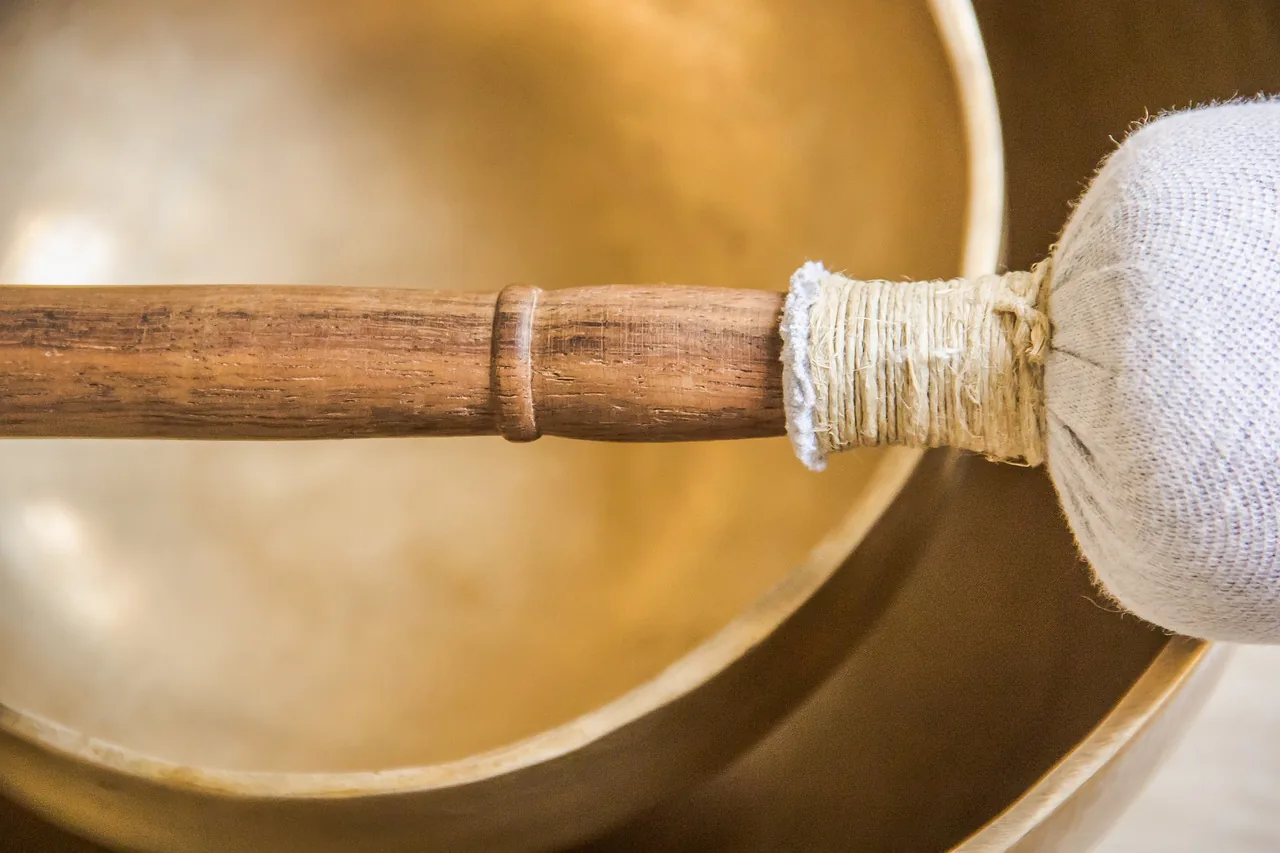
The sound generator can be seen as a texture maker: striking produces an attack followed by decay, while rubbing creates a continuous tone.
Sustained note, harmonics, and immersion
The “music” here is based on a prolonged note (drone) enriched with harmonics. Resonance creates a sense of space.
| Criterion | Handmade | Industrial |
|---|---|---|
| Manufacturing | Melting at ~1200°C, hand hammering | Casting and mechanical finishing |
| Harmonics | Richer, sustain up to ~60 s | Reduced harmonics, shorter sustain |
| Listening | Greater depth for immersion | Less texture for passive listening |
Practical cue: in a track, look for a clear attack, audible sustain, and harmonics that seem to “float”. For an example session and resources, see a sound bath.
Why these sounds soothe: psychoacoustic basics and the nervous system
A regular sound stimulus acts as an anchor point for attention and helps vigilance drop. Stable sound helps the nervous system move from alert mode toward a calmer state without making medical promises.
Brainwave entrainment
Research on brainwave entrainment shows that the brain tends to synchronize with regular patterns. Alpha and theta brainwaves are often associated with a meditative state, but they are markers, not guarantees.
The power of sustained notes
The sustained note, or drone, “occupies” attention. It reduces the search for novelty and plays a role similar to the breath in meditation practice. This anchoring power is simple and observable.
Active listening vs. passive listening
Passive listening puts the track in the background; active listening places attention on the attack, resonance, and harmonics. This supports deeper relaxation.
| Aspects | Passive listening | Active listening |
|---|---|---|
| Attention | Divided | Focused |
| Effect on the system | Low modulation of the nervous system | Better synchronization of waves |
| Recommended practice | Background atmosphere | Short protocol (see below) |
| Result | Temporary comfort | Better attentional stability |
Mini protocol: choose a passage, close your eyes, follow the attack and then the resonance until silence. Notice 2 harmonics; bring attention back to the sound with each distraction.
To explore sources and practical approaches further, see a dedicated selection on the wisdom of sound.
Vibrations, body, and mind: what observations and cited studies say
Observing the effect of vibrations on the body and mind helps connect lived sensations with scientific measures.

A cautious summary. Many first-hand reports and a few cited studies associate these sounds with lower stress, relaxation of the nervous system, and subjective benefits. This is wellness support, not a treatment.
Stress reduction and cortisol
Cortisol is often used as a simplified indicator. Cited data: an INSERM study (2021) reports an average 37% decrease in cortisol after a session — to be understood in relation to its protocol and population.
Resonance and body perception
The body perceives sound through the ear, but also through conduction and tissue vibration. In a sound bath, low frequencies and long sustain create an enveloping effect that helps release tension.
Mental clarity, concentration, and the parasympathetic system
A stable sound object simplifies attention. This supports concentration and mental clarity while activating the parasympathetic system (slow breathing, short heart-coherence practice recommended).
Evening use and caution
For deep relaxation before sleep: low volume, continuity, and avoiding strong strikes and sudden changes. In cases of hyperacusis, migraines, or tinnitus, test briefly, lower the volume, and stop if discomfort appears.
For additional resources on the subject, see a selection dedicated to sound art.
Tibetan bowl music: playlists, durations, and goals
Choosing a list according to intention radically changes the listening experience.
Relaxation and anti-stress
Favor regular textures: spaced strikes, sustained rubbing, few elements. Repetition reduces attention spikes and helps the system calm vigilance.
Meditation
Choose sounds that leave space: a long drone, clear harmonics. Avoid overstimulation, intrusive melodies, or too many instruments. This supports alpha and theta states without medical promises.
Sleep
Choose continuity: long tracks, low volume, no sharp cuts. Choppy compilations restart attention; prefer the same track on loop or recordings without abrupt silence.
Recommended durations
- Micro-break: 3–7 minutes (breathing, heart coherence).
- Guided session: 15–25 minutes (short meditation).
- Immersion/bath: 45–90 minutes (home session).
Avoiding the “zapping” effect
Interruptions caused by a change of track, volume, or timbre restart vigilance. Solutions: loop playback, fades, ad-free lists.
Mini checklist: airplane mode, notifications off, timer, volume test, clear intention (relax / meditate / sleep).
Creating a sound bath session at home
Setting up a session at home requires as much attention to atmosphere as to the choice of sound sources.

Prepare the space
Reduce interruptions: airplane mode, notifications off, timer set.
Choose soft light, a stable temperature, and a blanket. Decide between headphones for immersion or speakers for an enveloping feel.
Simple, comfortable posture
Lying on a mat or seated, neck supported, hands relaxed. A sleep mask helps reduce visual load.
Choose the sound sources
A single bowl offers a simple method. Adding gongs, chimes, or natural sounds enriches the texture, but “more” is not necessarily better if the intention is deep relaxation.
Reproducible structure
- 1 minute: set the intention.
- 3 minutes: slow breathing.
- 10–30 minutes: focused listening.
- 2 minutes: return to silence.
Short formats for everyday life
Add 5 to 7 minutes of heart coherence with a soft sound background. Initiatives such as SNCF/TGV tutorials show that these brief formats work in an active life.
“When the mind wanders, bring attention back to the resonance as you would return to the breath.”
Cautions: avoid volumes that are too loud, tracks with ads or overly bright sounds, and do not do the session while multitasking.
To go further, discover resources on roots music and chants.
Length of a session with a practitioner: what to expect in France
Before the first note, the practitioner spends a few minutes discussing your intention and checking your comfort. Then you settle lying on a mat, covered with a blanket, eyes closed.
Typical sequence
The session begins gently. The practitioner chooses singing bowls suited to the need, sometimes complemented by gongs or drums.
The progression follows a logic: gentle introduction, establishment of a stable background, subtle variations in timbre and intensity, then a decay toward silence.
Duration ranges
In France, the most common formats range from 30 to 60 minutes. Shorter discovery formats and longer sound journeys also exist.
The practitioner adjusts the distance of the instruments, the force of the strikes, and the alternation between rubbed bowl and struck bowl according to the body’s response.
State your goal before booking: anti-stress, meditation support, sleep preparation, or simple curiosity. This guides the session choice and improves its relevance.
Pitfall to avoid: believing that a session replaces medical care; it is support for well-being and nervous-system regulation.
Sound quality and instrument choice: craftsmanship, harmonics, and recordings
Sound quality turns passive listening into full immersion. A sound rich in harmonics and with clean sustain makes relaxation easier. Conversely, a harsh timbre tires attention.
Handmade bowls versus industrial production
Handmade: melting at ~1,200°C, hammering for ~8 h; longer sustain, denser harmonics (benchmark up to ~60 s).
Industrial: mechanical manufacturing; often shorter sustain.
Alloys and the “seven metals” narrative
The legend of the “7 metals” is often used for marketing. Several producers speak instead of 5 to 6 alloys. Avoid overinterpretation: assigning a metal to an organ remains speculative.
Criteria for a good recording
- natural dynamics without aggressive compression;
- silences respected between strikes;
- no digital hiss or sudden variations.
“Do not rely only on the displayed frequency: the structure of the sound matters more.”
Practical tip: test the same track on headphones and then on speakers, at low volume. Note what soothes you (timbre, resonance, transitions) to refine your choice. For an example of a sound journey, see sound journey.
Conclusion
In the end, consistency comes first: the strength of these sounds rests on stability, repetition, the sustained note, and harmonic richness. These elements support real benefits for the body and mind when listening remains coherent.
Choose a track according to your need: meditation, relaxation, or sleep. One long piece with no break offers a better experience than choppy collections.
Simple practice: 10 to 15 regular minutes often outperform a long but rare session. This routine supports grounding of the mind and relaxation of the body.
Active listening: follow the attack, notice the sustain, return to the sound when the mind drifts. Respect volume, your sensitivity, and consult a professional if you have a health concern.
Immediate action: start a continuous track, set a timer, try it tonight in sleep mode at low volume, then adjust according to the body’s and mind’s response.