
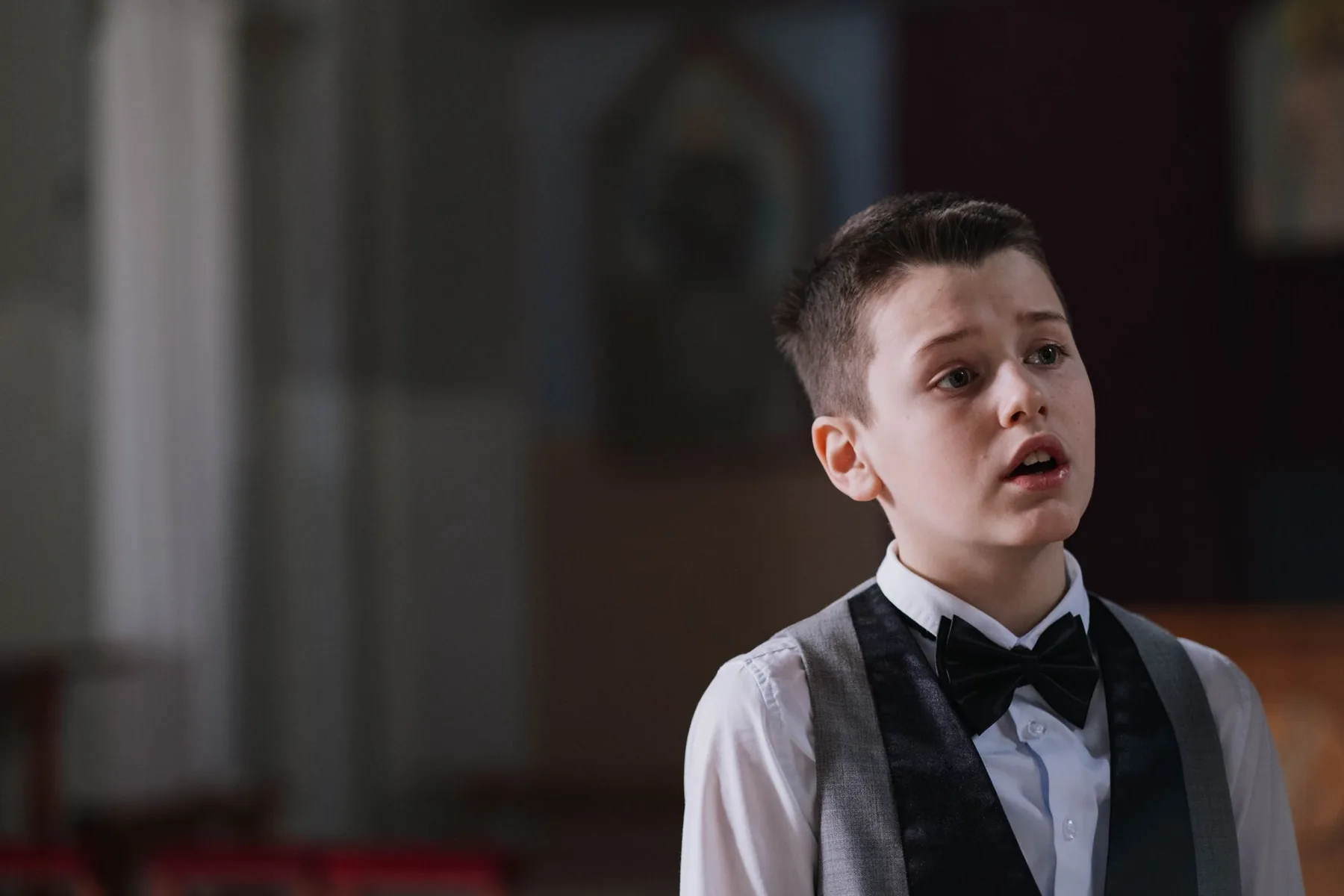
For centuries, the Gloria has resounded in churches as a universal hymn. Rooted in Christian traditions, it celebrates the glory of God and unites the faithful during the Mass. Its origin goes back to the earliest days of the Church, when it was sung in Greek before being adapted into Latin.
This sacred chant has its roots in the Gospel of Luke, where the angels announce the birth of Christ. Today, it remains a pillar of the liturgy, carried by Gregorian melodies or modern compositions.
In this article, discover the history, words, and finest interpretations of this spiritual jewel. From Vivaldi to Poulenc, great composers have given it a unique voice.
Introduction to the Gloria, an angelic hymn
The fresco of Audressein reveals the essence of this sung prayer. Dating from the 14th century, it depicts angels intoning sacred words that evoke Luke 2:13-14. This biblical passage describes their message to the shepherds: “Glory to God in the highest, and peace on earth“.
First a simple antiphon, the Gloria became a structured hymn. It celebrates praise of the Trinity: Father, Son, and Spirit. Its development reflects the unity of Christian liturgies, from East to West.
Symbolically, it links two realities: the peace promised to humankind and divine glory. This duality has inspired artists and theologians for centuries.
In Byzantine as well as Roman churches, it holds a central place. The nine angelic choirs, often represented, recall its heavenly origin. The Catalan fresco is a vibrant testimony to this.
Origins and history of Gloria in excelsis Deo
The Christian East gave birth to a universal sung prayer. First recited in Greek, this praise was enriched over the centuries. It draws its first notes from Byzantine liturgies, where divine glory was celebrated with fervor.
Greek and Eastern roots
The primitive version of the Gloria appears in morning lauds. Its Greek text, structured in stanzas, reflects rhythmic poetry. Irish monasteries, such as Bangor, preserved these melodies in their manuscripts.
The Antiphonary of Bangor, dating from the 7th century, is a key witness. This rare book shows how communion between the Churches of East and West shaped the chant.
Adoption into Western liturgy
Reserved for bishops until the 12th century, the chant became more widely used under the name of Innocent III. Priests were then able to include it in their celebrations. Its introduction at the Christmas feast, attributed to Pope Telesphorus, marked a turning point.
Monks adapted its rhythm to make participation easier. Today, these notes still resound on days of great solemnity.
Religious chant “Gloria”: text and interpretations
Sacred Latin gives the Gloria a unique spiritual depth. Its words, handed down for centuries, carry both liturgical and poetic force. Let us explore their hidden meaning and their Christ-centered structure.
Latin text and English translation
The original version begins with “Gloria in excelsis Deo”. This praise of the Son of God is organized in three parts: glorification, supplication, and Trinitarian doxology.
The verse “Qui tollis peccata mundi” refers directly to the Agnus Dei. It highlights Christ’s redemptive role, a central theme in the Pauline epistles.
Analysis of key verses
“Cum Sancto Spiritu” illustrates post-Nicene Trinitarian development. The repetition of “miserere nobis” three times works as a mnemonic technique.
These invocations reflect divine love and grace. The number three symbolizes the perfection associated with the Trinity.
Theological structure of the Gloria
The structure of the Gloria reveals a unique theological depth. This sacred chant unites divine praise and human supplication, reflecting the harmony between heaven and earth. Its construction follows a threefold movement: glorification, invocation, and doxology.
Praise of the Trinity
The Gloria celebrates the Trinity as a whole. It synthesizes Johannine and synoptic Christologies, attributing glory to the Father, the Son, and the Spirit. This triple invocation recalls divine unity.
The phrase “Cum Sancto Spiritu” underlines this Trinitarian dimension. It makes present the communion of the faithful with the body of Christ, especially during the Eucharist.
The invocation of Christ and the Lamb of God
The double title “Filius Patris/Agnus Dei” reveals a rich Christology. It links Christ’s divine nature to his role in salvation, prefigured in Revelation.
The expression “qui tollis peccata mundi” points to the Agnus Dei. It announces redemption and eternal life, central themes of Western soteriology.
The Gloria in the Catholic Mass
At the heart of the liturgy, this hymn occupies an essential place. It marks the transition between the Kyrie and the Collect, creating a bridge between supplication and praise. Its unifying effect strengthens the active participation of the faithful.
When and how is it sung?
Reserved for Sundays and feasts, it rises after the Kyrie. Only the beginnings of Advent and Lent suspend its use. The melody generally follows a psalmodic or Gregorian tone.
Three forms coexist:
- Full Latin version
- Vernacular adaptations
- Shortened form for certain celebrations
Its liturgical role
This prayer fulfills several key functions:
| Function | Impact |
|---|---|
| Solemn opening | Prepares listeners for the Gospel |
| Upward dynamic | Connects earth to heaven |
| Communal unification | Strengthens collective participation |
Its pastoral power transforms the spiritual experience. The words “Glory to God in the highest” turn hearts toward transcendence.
This thousand-year-old prayer continues to vibrate in churches. It unites generations in the same praise, bearing witness to a living faith.
The different Gregorian versions
The Gregorian melodies of the Gloria offer fascinating liturgical diversity. Each version reflects distinct historical and geographical influences, forming a unique musical heritage.
Gloria VIII (De Angelis)
Called De Angelis, this syllabic model dates from the 10th century. Its melodic simplicity makes it accessible to communities. The Latin translation is especially clear, with balanced musical phrases.
One linguistic particularity stands out: the use of “Quia” rather than “Quoniam”. This nuance reveals medieval theological choices.
Gloria XV for solemn feasts
Reserved for major celebrations, this ornate style impresses with its complex neumes. Manuscripts from Franconia from the 9th to 12th centuries preserve its earliest notations.
Michel Huglo showed how these variations traveled across Europe. His study sheds light on the cultural exchanges of the Middle Ages.
Gloria XIV and its link with Greek
This version preserves traces of Byzantine pronunciation. Its rhythm evokes the chant’s Eastern origins, with characteristic melismas.
The Greek language still influences certain passages, as shown by the 10th-century Franconian adaptation. Today, Byzantine Catholic communities use it in their offices.
These musical treasures connect the Christian world in a single praise. Their preservation helps us understand the evolution of liturgical practice.
Musical plainchant and its development
From the 17th century onward, plainchant was transformed under the influence of new styles. This period saw the birth of simplified methods for adapting this vocal art to religious communities. Melodies that had once been complex gained clarity without losing their spiritual depth.
The syllabic and neumatic styles
Plainchant first adopted a syllabic style, in which each note corresponds to one syllable. This approach made learning easier. Methods such as those of Guillaume-Gabriel Nivers were recorded in books for seminaries.
The more ornate neumatic style survived for major feasts. These two forms coexisted, reflecting the richness of sacred musical culture.
The influence of Henry Du Mont
Among the notable composers, Henry Du Mont transformed plainchant. His “Royal Masses” for Versailles introduced measured, more rhythmic chant. This innovation inspired schools such as Saint-Sulpice.
Criticized for its simplification, his work nevertheless opened the way to the great Baroque motets. His legacy remains visible in the scores of the period.
| Style | Characteristics | Impact |
|---|---|---|
| Syllabic | One note = one syllable | Greater accessibility |
| Neumatic | Groups of notes per syllable | Greater expressiveness |
| Measured (Du Mont) | Regular rhythm | Transition toward the Baroque |
Famous interpretations of the Gloria
From Vivaldi to Bach, the Gloria has inspired timeless musical masterpieces. These orchestral versions transcend the liturgy to become concert pieces. They marry divine glory with the genius of composers.
Vivaldi and his three versions
Antonio Vivaldi’s Gloria RV 589 shines with Baroque vitality. Composed for the Ospedale della Pietà, it makes full use of female voices. Its contrasting movements alternate between jubilation and contemplation.
The structure in 12 sections reflects the diversity of spiritual emotions. Trumpets converse with choirs in a unique musical brilliance.
Poulenc’s Gloria
Francis Poulenc offered a modern reinterpretation in 1959. His work moves between mysticism and a typically French lightness. The “Domine Deus” particularly evokes the figure of the heavenly Father.
This score reveals the composer’s conversion. It fuses contemporary language and sacred tradition with rare sensitivity.
Bach’s Mass in B minor
Bach incorporates the Gloria into his monumental Symbolum Nicenum. He reuses motifs from the cantata BWV 191, enriched with new arrangements. Natural horns (corno da caccia) add a royal dimension.
The seven parts symbolize divine perfection. This numerical architecture testifies to the composer’s Lutheran spirituality.
| Composer | Characteristics | Notable instruments |
|---|---|---|
| Vivaldi | 12 contrasting movements | Trumpets, oboes |
| Poulenc | Harmonic modernity | Piano, percussion |
| Bach | Symbolic structure | Natural horns, organ |
These historical interpretations continue to inspire conductors. They prove the universality of this sacred music across the centuries.
The Old Roman Gloria and its manuscripts
Medieval manuscripts reveal hidden treasures of sacred chant. Among them, the Old Roman Gloria stands out for its linguistic and musical particularities. These ancient documents bear witness to a rich and complex liturgical tradition.
The Gradual of Saint Cecilia
Discovered in Rome, this 11th-century manuscript contains two versions of the Gloria. Its musical notation uses staffless neumes, typical of the period. Specialists have identified Byzantine and Gallican influences in it.
This exceptional document shows how the Latin language evolved. Some phrases differ from current versions, revealing particular theological choices.
“Comparison of the manuscripts shows incredible diversity in the transmission of the Gloria.”
Textual variations
The study of ancient sources reveals several phenomena:
- Additions of psalm verses in the Psalterium Gallicanum
- Variants in the translation from Greek to Latin
- Debates about the authenticity of certain doxologies
The phrase “Laudamus te” appears in as many as five different formulations. These variations reflect local adaptations and exchanges between monasteries.
| Manuscript | Particularities | Date |
|---|---|---|
| Gradual of Saint Cecilia | Double version of the Gloria | 11th century |
| Antiphonary of Bangor | Archaic notation | 7th century |
| Psalterium Gallicanum | Added psalm verses | 9th century |
The words of the Gloria thus traveled through the centuries. Each copy bore the mark of its cultural and liturgical context. These differences give new meaning to our understanding of sacred chant.
Monastic scriptoria played a key role in this transmission. Their copying methods had a lasting influence on the definitive form of the Gloria. To learn more about this development, see the full history of the Gloria.
The rhythm and musicality of the Gloria
The musicality of the Gloria rests on a unique rhythmic alchemy. This masterpiece of sacred art combines liturgical precision and vocal expression. Its structure follows musical principles transmitted since the Middle Ages.
The importance of the Latin accent
Latin pronunciation directly influences the rhythm. The Solesmes technique of the “grand rhythm” guides syllabic accentuation. It follows three key rules:
- Lengthening of accented vowels
- Respect for the natural breaks in the text
- Highlighting of theologically important words
In Gloria XV, this balance reaches perfection. The complex neumes follow the curves of the voice. Choir directors stress the accuracy of strong and weak beats.
Legato and the melodic phrase
Phrasing requires continuous breath. Traditional exercises develop this unified breath. They make it possible to link verses without interruption.
Three techniques optimize legato:
- Diaphragmatic preparation before climaxes
- Control of the air column on cadences
- Smooth transition between vocal registers
Ensemble Organum illustrates this mastery in its recordings. Its interpretation shows how spirituality and technique can be linked.
| Element | Gloria XIV | Gloria XV |
|---|---|---|
| Rhythm | Fluid, influenced by Greek | Solemn, with marked pauses |
| Phrasing | Natural legato | Precise articulation |
| Breathing | Long cycles | Strategic breaks |
These sacred chants continue to inspire performers. Their music integrates tradition and innovation, creating a bridge between past and present.
The Gloria in other Christian traditions
Eastern Churches developed their own interpretation of this universal hymn. Their approach reveals distinct theological and musical nuances. These variations enrich the understanding of this thousand-year-old praise.
Orthodox and Byzantine use
In the Byzantine rite, the Gloria takes a specific poetic form. It is often sung in Greek during Matins. This version emphasizes Trinitarian glory with modal melodies.
Slavic Churches sometimes use an Old Slavonic translation. The acoustic effect differs noticeably from Latin interpretations. Male choirs predominate in this tradition.
Comparison with the Te Deum
These two hymns share 24 to 26 similar verses in certain manuscripts. The Te Deum, however, includes additional prophetic references. Their shared text shows crossed liturgical influences.
Major points of divergence:
- A more narrative structure in the Te Deum
- Different use in the liturgical calendar
- Contrasting musical treatment depending on the period
| Aspect | Gloria | Te Deum |
|---|---|---|
| Origin | 2nd-3rd century | 4th century |
| Use | Mass | Liturgy of the Hours |
| Central theme | Trinitarian praise | History of salvation |
These traditions show how the same part of faith can be expressed in different ways. Each rite preserves its identity while celebrating Christian unity.
Symbolism and spirituality of the Gloria
Christmas and Easter find their echo in this thousand-year-old hymn. The Gloria unites two sacred dimensions: the peace promised to humankind and divine glory. This duality makes it a pillar of major Christian celebrations.
The light of Christmas
During the feast of the Nativity, the Gloria shines with particular radiance. Popular traditions associate it with luminous symbols:
- The release of bells to mark joy
- The use of the tintinnabulum during the chant
- Parallels with the angelic announcements
Medieval manuscripts often show angels holding scrolls with the first words of the Gloria. This iconography links the birth of Christ to heavenly praise.
Easter solemnity
At Easter, the bishop’s intonation during the Vigil gives the Gloria a unique gravity. This key moment of liturgical time recalls several aspects:
- The salvation brought by the Resurrection
- The parallel with the Exultet
- Its role in the formation of catechumens
| Element | Christmas | Easter |
|---|---|---|
| Symbolism | Emerging light | Victory over death |
| Ritual | Ringing bells | Solemn chant |
| Liturgical color | White and gold | Brilliant white |
“The Easter Gloria is a cry of victory that crosses the centuries.”
These two major feasts show how the Gloria accompanies the cycle of Christian life. From the manger to the empty tomb, it sings the same hope.
The Gloria in art and culture
From painting to contemporary music, this hymn inspires creators. Its universal message has crossed the centuries to enrich our cultural heritage. Artists find in it an inexhaustible source of beauty and spirituality.
Pictorial heritage
Medieval frescoes often show angels holding scrolls with the first words of the Gloria. This iconographic motif links heaven and earth. It appears in both Romanesque and Gothic churches.
In cinema, major works have used this hymn. The Mission and The Tree of Life make it a key element of their soundtracks. These choices strengthen the spiritual dimension of the narratives.
Musical reinventions
Modern composers reinterpret this masterpiece boldly. Arvo Pärt wrote a purified a cappella version in 1989. His minimalist style gives new depth to the voices.
Other innovative approaches deserve attention:
- Duke Ellington’s sacred jazz
- Gubaidulina’s electroacoustic experiments
- John Zorn’s interreligious fusions
| Style | Artist | Particularity |
|---|---|---|
| Minimalism | Tavener | Expressive silences |
| Cinema | Morricone | Dramatic use |
| Fusion | Sufi chant | Dialogue of traditions |
This artistic richness shows how the Gloria surpasses the boundaries of time. It continues to inspire creators in varied fields. Music and the visual arts bear witness to it.
Historical manuscripts and their conservation
These precious documents open a window onto medieval musical practices. Fragile witnesses of the past, they require constant attention to preserve their sacred music. Their study sheds light on our understanding of ancient liturgy.
The Antiphonary of Bangor
Discovered in Ireland, this 7th-century collection contains unique notations. Its staffless neumes pose challenges of interpretation. Scholars such as Dom Cardine have pierced their mysteries.
This manuscript reveals:
- Vocal techniques specific to Celtic monasticism
- A transition between oral and written traditions
- The importance of abbeys in musical transmission
The chant books of Saint Gall
The Codex Sangallensis 359 from the 10th century is a jewel of the Swiss abbey. Its St. Gall neumes still guide Gregorian performers. UNESCO recognizes its universal value.
“The neumes of Saint Gall are like a living score, linking us directly to the chant of medieval monks.”
Current conservation techniques include:
- High-resolution digitization
- Strict control of humidity and light
- Meticulous restoration of parchments
The permanent exhibition in Saint Gall allows the public to admire these treasures. Each page tells a story of voices and spirituality across the centuries.
How can the Gloria be sung today?
Innovative tools now make this repertoire easier to master. Choirs and soloists benefit from methods adapted to contemporary realities. This essential part of the liturgy calls for a balanced approach between tradition and modernity.
Technical advice for ensembles
A good interpretation rests on three pillars:
- Breathing: favor long cycles for melodic phrases
- Pronunciation: work on Latin with a vocal coach if necessary
- Rhythm: use a metronome for complex passages
Rehearsals should be regular, especially before major liturgical days. Reference recordings help calibrate the interpretation.
Essential teaching tools
Several resources make learning accessible:
- Specialized applications (Gregobase, Cantus)
- Online masterclasses offered by the CMAA
- Scores in Vatican notation to respect the nuances
A good reference book, such as the Roman Parishioner, complements these digital tools. Sacred music gains depth through these varied supports.
| Resource | Advantages | Required level |
|---|---|---|
| Courses at Solesmes | Total immersion with the monks | Intermediate/advanced |
| Reference recordings | Models of authentic interpretation | All levels |
| Mobile applications | Progressive learning | Beginner |
“The beauty of the Gloria lies in its universality. Every generation can find its own voice in it.”
This thousand-year-old prayer continues to unite believers across the centuries. With the right methods, everyone can contribute to its living transmission.
Conclusion: the timeless legacy of the Gloria
This liturgical jewel crosses the ages without losing its spiritual power. Its text, bearer of the glory of God, has united the faithful since the 2nd century. Despite reforms, it remains a pillar of the Mass, adapted into languages while preserving its essence.
Its sacred music transcends divisions. From Gothic cathedrals to modern chapels, it embodies Christian unity. The peace promised in its verses still resonates today.
In the face of contemporary challenges, the Gloria invites a collective experience. Whether sung in Latin or in the vernacular, its message of praise remains intact. A living heritage, to be rediscovered again and again.
FAQ
What is the origin of the Gloria in Christian liturgy?
What is the role of the Gloria in the Eucharistic celebration?
Are there differences between the Gregorian versions?
Why is the Latin text still used today?
Which composers shaped the history of the Gloria?
How should the musical nuances be interpreted correctly?
Where can historical manuscripts of the Gloria be found?
Is the Gloria present in other Christian rites?
Can one learn to sing the Gloria without formal training?
Source Links
- https://www.newadvent.org/cathen/06583a.htm
- https://www.vatican.va/archive/ENG0015/__P3A.HTM
- https://www.britannica.com/art/Gregorian-chant
- https://www.jstor.org/stable/766362
- https://www.britannica.com/art/Gregorian-chant
- https://www.usccb.org/committees/divine-worship/policies
- https://www.usccb.org/prayer-worship/liturgical-year/easter
- https://www.usccb.org/offices/public-affairs/structure-and-meaning-mass
- https://adoremus.org/2007/12/musicam-sacram-instruction-on-music-in-the-liturgy/
- https://gregobase.selapa.net/
- https://www.britannica.com/art/Gregorian-chant
- https://imslp.org/wiki/Gloria%2C_RV_589_(Vivaldi%2C_Antonio)
- https://www.liturgyoffice.org.uk/Missal/
- https://www.hyperion-records.co.uk/c.asp?c=C1225
- https://imslp.org/wiki/Category:Masses
- https://www.britannica.com/art/Gregorian-chant
- https://www.bbc.co.uk/programmes/genres
- https://adoremus.org/2007/12/musicam-sacram-instruction-on-music-in-the-liturgy/
- https://adoremus.org/2007/12/musicam-sacram-instruction-on-music-in-the-liturgy/
- https://www.liturgyoffice.org.uk/Resources/Music/